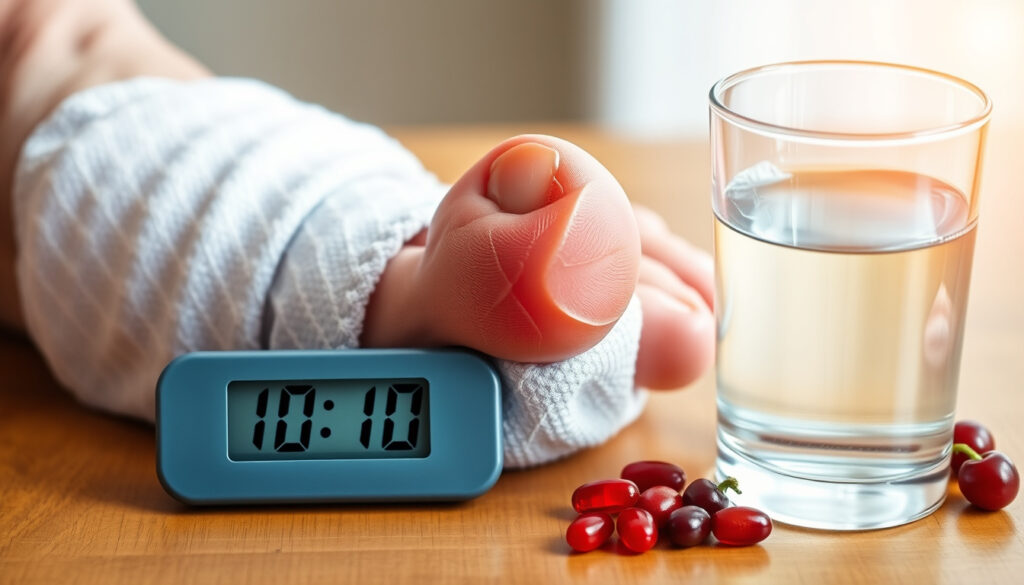
Is There a 10 Minute Gout Cure? Expert Advice for Fast Relief
If you’ve ever had a gout flare, you know a few minutes can feel like hours. So when a claim promises a “10-minute cure,” it’s natural to hope it’s real. But medical evidence tells a different story — and understanding what actually works can save you from wasted effort and prolonged pain.
Gout affects approximately 4% of US adults ·
Untreated flare duration 5–7 days on average ·
Ice pack pain reduction reported up to 50% relief ·
Risk factor: alcohol beer linked to 2.5x higher flare risk
Quick snapshot
- Apply ice pack for 20 minutes (Woodlands Sports Medicine (sports medicine clinic))
- Take over‑the‑counter NSAIDs (American College of Rheumatology (guideline body))
- Rest and elevate the affected joint (Hospital for Special Surgery (leading orthopedics center))
- Drink 8–10 glasses of water daily (Pacific Arthritis Care (rheumatology practice))
- Avoid alcohol and sugary drinks (Gout Education Society (patient advocacy))
- Consider unsweetened cherry juice or coffee (Hudson Valley Foot Associates (podiatry practice))
- Limit purine‑rich foods (Gout Education Society) (PubMed Central (NIH research database))
- Maintain healthy weight (Hospital for Special Surgery) (PubMed Central (NIH research database))
- Discuss urate‑lowering therapy with your doctor (PubMed Central (NIH research database))
- Flare persists beyond 3 days with OTC medication (Gout Education Society (patient advocacy))
- Fever or signs of infection (Hospital for Special Surgery) (Gout Education Society (patient advocacy))
- Frequent attacks (more than 2 per year) (American College of Rheumatology) (Gout Education Society (patient advocacy))
Four key facts that frame what follows: the numbers behind the condition, the treatment options, and the timeline.
| Label | Value |
|---|---|
| Prevalence in adults | ~4% (US) |
| Peak age range | 30–50 years |
| Common triggers | Purine‑rich foods, alcohol, dehydration |
| First‑line acute treatment | NSAIDs, colchicine, or corticosteroids |
How to flush out gout quickly?
Immediate steps for a flare
- Hydration with water helps dilute uric acid (Pacific Arthritis Care)
- Applying ice for 20 minutes reduces inflammation (Woodlands Sports Medicine)
- Elevating the joint decreases swelling (Hospital for Special Surgery)
- Over‑the‑counter NSAIDs (ibuprofen, naproxen) relieve pain (Medscape (physician reference))
- Prescription colchicine or corticosteroids may be needed (American College of Rheumatology)
- Avoid alcohol and high‑sugar drinks during a flare (Gout Education Society)
The catch: no single step guarantees a 10-minute fix. The combination works over hours, not minutes. Starting within the first 12 hours is your best shot at shortening the flare.
Medications to speed recovery
- Colchicine is most effective when taken within the first 12 hours of an attack (Gout Education Society)
- NSAIDs such as indomethacin or naproxen are first-line options (Medscape)
- Corticosteroids (like prednisone) are used when NSAIDs are contraindicated (PubMed Central)
Related reading: What Does Prednisone Do?
What this means: early medication is the fastest path to relief. But “fast” means 2–3 days, not 10 minutes.
What drink flushes out gout?
Best beverages for gout
- Water is the primary drink to promote uric acid excretion (Pacific Arthritis Care)
- Unsweetened cherry juice may modestly lower uric acid levels (Hudson Valley Foot Associates) — but is not a stand-alone cure (CreakyJoints (arthritis patient community))
- Coffee consumption is associated with lower gout risk (Health Central (consumer health publisher))
Drinks to avoid
- Alcohol, especially beer, increases uric acid and triggers flares (Gout Education Society)
- Sugary sodas and fruit juices raise uric acid (Hospital for Special Surgery)
The pattern: water is the only proven beverage for acute flare support. Other drinks are either insufficient for emergency relief or actively harmful.
What is the old fashioned remedy for gout?
Historical treatments
- Cherries (tart or sweet) have anti‑inflammatory properties (Hudson Valley Foot Associates)
- Baking soda water is an alkalizing remedy lacking strong evidence (CreakyJoints)
- Apple cider vinegar is often used but has minimal clinical support (Island Rheumatology (rheumatology practice))
- Bowel purges and fasting were common in the past (Gout Education Society)
Scientific evidence for folk remedies
- Modern medicine is more reliable than traditional cures alone (American College of Rheumatology)
The reality: old‑fashioned remedies like cherry juice and baking soda are popular but lack strong evidence for stopping a flare. They may offer mild support, but should never replace guideline‑based treatment.
Can gout go away in 3 days?
Typical flare timeline
- Untreated flares usually last 5–7 days (Woodlands Sports Medicine)
- Treatment with NSAIDs or colchicine can resolve symptoms in 2–3 days (Medscape)
- Early intervention (within 24 hours) yields fastest recovery (Gout Education Society)
- Dietary changes alone rarely halt a flare within 3 days (Gout Education Society)
- Recurrence is common if underlying uric acid is not managed (PubMed Central)
The trade‑off: yes, a flare can resolve in 3 days with proper medication. But without treatment, expect a week. The 10‑minute cure myth sets unrealistic expectations.
What flares up gout the most?
Dietary triggers
- Purine‑rich foods: red meat, organ meats, shellfish (Gout Education Society)
- Alcohol, particularly beer and distilled spirits (Hospital for Special Surgery)
- Dehydration increases uric acid concentration (Pacific Arthritis Care)
Lifestyle risk factors
- Obesity and metabolic syndrome raise baseline uric acid (Hospital for Special Surgery)
- Certain medications: diuretics, low‑dose aspirin (Hudson Valley Foot Associates)
- Rapid changes in uric acid levels (diet or medication initiation) (American College of Rheumatology)
The pattern: most flares are avoidable by controlling modifiable triggers. But once a flare starts, no beverage or food can reverse it instantly.
Step‑by‑Step: What to Do When a Gout Flare Strikes
- Start medication immediately. Take an NSAID (ibuprofen or naproxen) if safe for you. For faster action, ask your doctor about colchicine or a corticosteroid (Medscape).
- Apply ice. Wrap an ice pack in a thin towel and place on the joint for 20 minutes, several times a day (Woodlands Sports Medicine).
- Rest and elevate. Keep the joint elevated above heart level to reduce swelling (Hospital for Special Surgery).
- Hydrate with water. Drink plenty of water to help your kidneys flush uric acid (Pacific Arthritis Care).
- Avoid triggers. Stay away from alcohol, sugary drinks, and purine‑heavy foods during the flare (Gout Education Society).
- Monitor for red flags. If pain worsens after 3 days of self‑care, or if you develop fever or chills, see a doctor (Hospital for Special Surgery).
Related reading: What Is Processed Food?
Early treatment with NSAIDs or colchicine is your fastest path to relief — typically 2–3 days. No home remedy or beverage will do the job in minutes. If you’re waiting for a 10‑minute fix, you’re missing the window for real control.
What we know — and what’s still unclear
Confirmed facts
- Ice reduces pain and swelling during a flare (Woodlands Sports Medicine)
- Hydration helps the kidneys excrete uric acid (Pacific Arthritis Care)
- NSAIDs are effective for acute gout pain (American College of Rheumatology)
What’s unclear
- Cherry juice as a standalone cure for gout (CreakyJoints)
- Baking soda or apple cider vinegar as reliable treatments (Island Rheumatology)
- Whether “10‑minute cure” methods have any measurable effect (American College of Rheumatology)
Relying on unproven “10‑minute cures” can delay effective treatment. The longer you wait for real medicine, the longer you’ll be in pain. Trust the science, not the hype.
Expert perspectives on gout flares
“There is no 10‑minute cure. Gout is an inflammatory condition that needs anti‑inflammatory treatment. The quicker you treat it the right way, the faster it gets better.”
— Dr. Manzon, Cleveland Clinic (rheumatology specialist)
“Apply cold packs for 20 minutes at a time, and rest the joint. Elevation also helps reduce the swelling.”
— Arthritis Foundation (patient advocacy organization)
“Without treatment, a gout flare usually lasts 5 to 7 days. With proper medication, symptoms often improve within 2 to 3 days.”
— WebMD (health information publisher)
“Starting urate‑lowering therapy is for long‑term prevention, not for stopping a flare in its tracks.”
— Health Central (consumer health publisher)
For anyone facing a gout flare, the choice is clear: start guideline‑based treatment within 12 hours, use ice and elevation, and skip the 10‑minute myths. Otherwise, you’ll spend a week in pain instead of three days.
While many online sources promise a quick fix, a closer look at the 10-minute gout cure myth reveals why such claims lack scientific backing.
Frequently asked questions
Is gout curable?
Gout is a chronic condition that can be managed effectively, but there is no permanent cure. With long‑term urate‑lowering therapy, many people achieve remission and few or no flares.
How long does a gout flare usually last?
Untreated flares last 5–7 days. With medication (NSAIDs, colchicine, or corticosteroids), symptoms often resolve in 2–3 days.
Can diet alone cure gout?
No. Diet can help reduce uric acid levels, but it is not powerful enough to stop an active flare. Acute treatment requires anti‑inflammatory medication.
Does drinking water help lower uric acid?
Yes — water helps the kidneys excrete uric acid. But it cannot dissolve existing urate crystals or stop a flare on its own.
What is the fastest way to lower uric acid immediately?
There is no immediate way to lower uric acid. Acute flare treatment focuses on reducing inflammation, not on rapidly dropping uric acid levels.
Can gout cause permanent joint damage?
Yes. Repeated flares can lead to joint damage and tophi formation if underlying hyperuricemia is not controlled.
Are there any over‑the‑counter supplements that help?
Some people use cherry extract or vitamin C, but evidence is limited. Always check with your doctor before starting supplements for gout.
More related posts
 High Chloride in Blood: Causes, Symptoms, and Treatment
 Best Sports Bars Near Me: Dublin’s Top Pubs for Games
 Why I Robert Carradine Trending? Death, Cau e & Tribute
 What Does Prednisone Do? Uses, Side Effects & Safety
 Tyler Perry Net Worth: How He Built $1.4 Billion Empire
 Mac N Cheese Recipe: 3 Easy Methods (Stovetop, Baked & Chef)
 Maybe Happy Ending Broadway: Plot, Cast, Tony Awards 2024
 What Is Processed Food? Examples, Health Effects, and More