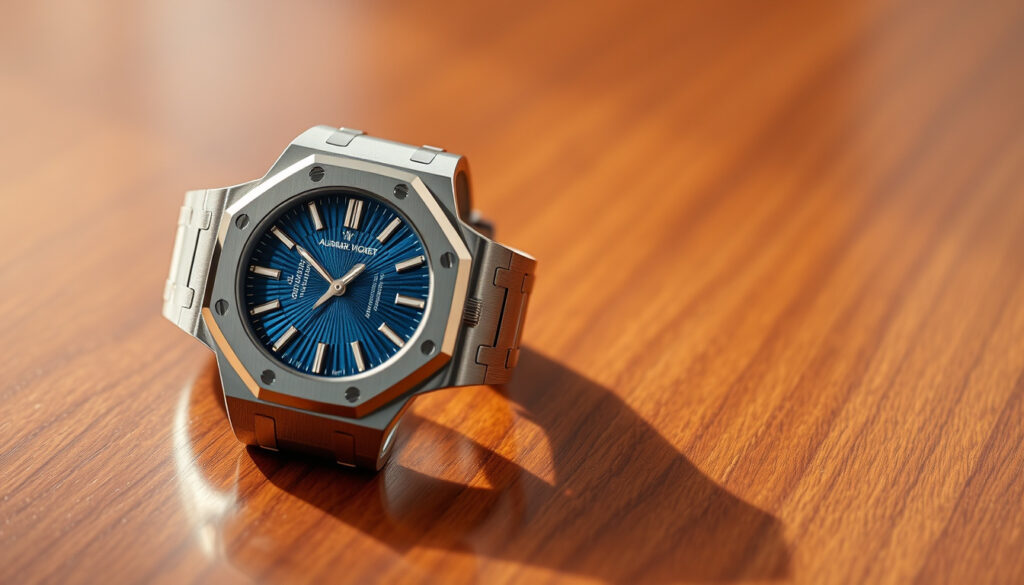
Audemars Piguet Royal Oak: Price Guide & History
There’s a reason watch enthusiasts obsess over the Audemars Piguet Royal Oak: its octagonal bezel and integrated bracelet remain instantly recognizable. But the price tag can be just as striking — on Chrono24, stainless steel models start around $31,500 USD, and this guide examines the Royal Oak’s pricing, compares it with rivals like Rolex and Patek Philippe, and unpacks the history that made it a legend.
List price (automatic 37mm): $30,400 (Luxury Bazaar) ·
Average secondary market: $49,000 (WatchCharts) ·
Entry-level quartz: $19,900 (Luxury Bazaar)
Quick snapshot
- Launched in 1972 as a last-chance effort to save Audemars Piguet (Chrono24)
- Designed by Gérald Genta (Luxury Bazaar)
- Octagonal bezel with eight hex screws (Chrono24)
- First luxury steel sports watch (WatchCharts)
- Exact current market price depends on condition, age, and seller (Chrono24)
- Whether AP is “better” than Patek Philippe remains subjective (Timepiece Trading LLC)
- How price changes affect future secondary market trends is not yet known (Chrono24)
- The exact market share of Royal Oak in the luxury sports watch segment is not publicly available (Chrono24)
- 2025: 150th-anniversary RD#5 limited to 150 pieces (Luxury Bazaar)
- Secondary prices for steel models reached $31,500+ (Chrono24)
- Demand continues to drive premiums over retail (WatchCharts)
- Limited editions push prices into six figures (Luxury Bazaar)
The Royal Oak’s specifications reveal its blend of heritage and modern engineering.
| Attribute | Value |
|---|---|
| Retail price (steel) | ~$22,500 (new, steel) (Luxury Bazaar) |
| Case diameter | 39mm – 42mm (varies by reference) |
| Water resistance | 50 meters (typical) |
| Movement | Automatic, in-house caliber |
| Power reserve | ~60 hours |
| Average secondary price | $49,000 (WatchCharts) |
How much does an AP Royal Oak cost?
Current price range for new models
- Automatic 37mm (stainless steel): $30,400 list price (Luxury Bazaar)
- Quartz 33mm (stainless steel): $19,900 list price (Luxury Bazaar)
- Gold models: from $86,900 to over $124,200 (Luxury Bazaar)
Pre-owned and vintage pricing
- Stainless steel models on Chrono24 start around $31,500 (Chrono24)
- “Jumbo” Extra-Thin 15202ST: $73,000 (Chrono24)
- Private-sale prices seen from €5,908 to €378,435 (WatchCharts)
What this means: buyers who want the iconic 39mm steel model should budget at least $31,500 on the used market — and often more for desirable references.
Cheapest entry-level Royal Oak
- The least expensive new Royal Oak is the 33mm quartz model at $19,900 (Luxury Bazaar)
- Pre-owned quartz examples can be found below $15,000 depending on condition (Chrono24)
The quartz Royal Oak wears smaller and has a different movement character. Purists often recommend stretching for an automatic if you want the full integrated-bracelet experience.
The implication: Buyers must weigh size and movement preferences against budget.
Is AP higher end than Rolex?
Brand positioning and heritage
- Audemars Piguet is widely seen as more exclusive, producing fewer watches per year than Rolex (Luxury Bazaar)
- The Royal Oak is credited as the first luxury steel sports watch, a category Rolex popularized later (WatchCharts)
One comparison: Rolex’s Submariner Date retails at $11,350 (Rolex) — less than half the price of a steel Royal Oak. Yet Rolex moves far more units, keeping its brand mass.
Price comparison: AP vs Rolex
| Model | Retail price (new) | Secondary premium |
|---|---|---|
| AP Royal Oak (steel auto) | $30,400 (Luxury Bazaar) | ~60% above retail |
| Rolex Submariner Date (steel) | $11,350 (Rolex) | ~30-50% above retail |
The pattern: AP prices are higher at entry and command larger secondary premiums, reflecting its rarer production and status.
Materials and craftsmanship differences
- AP uses high-grade finishing with hand-polished bevels and tapisserie dials (Chrono24)
- Rolex focuses on robust, mass-produced movements with less hand finishing (Bob’s Watches)
For buyers seeking handcrafted detail and exclusivity, AP wins. For everyday durability and easier service, Rolex is more practical.
The catch: The choice hinges on whether you prioritize exclusivity and finishing or ruggedness and serviceability.
Is Audemars Piguet better than Patek Philippe?
Design philosophy differences
- AP Royal Oak: sporty, octagonal, integrated bracelet (Chrono24)
- Patek Philippe Nautilus: more rounded, porthole-inspired design (Timepiece Trading LLC)
Price and collectibility
- Nautilus retail price: $89,773 (WatchCharts); market price: $174,772
- Royal Oak Jumbo: $73,000 secondary (Chrono24)
- Both brands hold value well, but Patek often achieves higher premiums on ultra-rare references (Timepiece Trading LLC)
The catch: “better” depends on taste. Patek is more traditional and dressy; AP is bolder and more casual. In terms of investment, both top-tier, but Patek’s classical appeal sometimes edges ahead.
| Feature | AP Royal Oak (steel) | Patek Nautilus (steel) | Rolex Submariner (steel) |
|---|---|---|---|
| Retail price (approx.) | $30,400 | $89,773 | $11,350 |
| Case style | Octagonal / integrated | Porthole / integrated | Round / Oyster |
| Water resistance | 50m | 120m | 300m |
| Movement | In-house automatic | In-house automatic | In-house automatic |
| Secondary premium | High | Very high | Moderate |
The implication: The Royal Oak offers a unique blend of sporty design and high collectibility, but the Nautilus commands a higher price ceiling.
Audemars Piguet Royal Oak Offshore vs classic Royal Oak
Size and design differences
- Classic Royal Oak: 39–42mm, slim profile (Chrono24)
- Royal Oak Offshore: 42–48mm, chunkier, more robust (Luxury Bazaar)
Price comparison
- Classic steel: $30,400 – $73,000
- Offshore Chameleon (37mm): $48,900 (Luxury Bazaar)
The trade-off: Offshore offers more presence and durability, but the classic remains thinner and more elegant. Dress-watch fans prefer the classic; weekend warriors lean Offshore.
Timeline of the Royal Oak
- 1972: Royal Oak launched, designed by Gérald Genta (Chrono24)
- 1993: Royal Oak Offshore introduced (Luxury Bazaar)
- 2020s: Secondary prices surge; limited editions command six figures (WatchCharts)
The pattern: Key milestones show the Royal Oak’s evolution from a desperate gamble to a cultural icon.
What’s confirmed — and what’s still unclear
Confirmed facts
- Royal Oak debuted in 1972 (Chrono24)
- Designed by Gérald Genta (Luxury Bazaar)
- Octagonal bezel with eight screws (Chrono24)
- Steel automatic model starts at $30,400 retail (Luxury Bazaar)
What’s unclear
- Exact market price fluctuates daily with supply and demand (Chrono24)
- Is AP “better” than Patek? — subjective; both are elite (Timepiece Trading LLC)
The catch: Even with confirmed facts, the dynamic market means prices shift regularly.
Expert perspectives
The original Royal Oak was a last-chance effort to save the company.
— Watchfinder editorial (Chrono24)
Gérald Genta considered the Royal Oak his most famous design.
— Gérald Genta (designer) (Luxury Bazaar)
What this means: The watch’s origin story amplifies its collectible mystique.
Summary
For buyers in the United States, the Audemars Piguet Royal Oak stands as a distinct choice among luxury watches. Its pricing starts near $30,000 and quickly climbs, placing it firmly above Rolex and on par with Patek Philippe in terms of status. The decision is clear: if you value sporty elegance and a storied history, the Royal Oak remains unmatched — but be prepared to pay a premium for that legacy.
luxurybazaar.com, wywatl.com, chrono24.com, huntingtonwatch.com, chrono24.com, luxurybazaar.com, youtube.com
Frequently asked questions
What is the history of the Audemars Piguet Royal Oak?
Introduced in 1972, it was designed by Gérald Genta as a bold steel sports watch to rescue the struggling brand. It became the first luxury steel sports watch and defined an entire category.
How does the Royal Oak compare to the Patek Philippe Nautilus?
Both are integrated-bracelet sports watches. The Royal Oak is more angular and sporty; the Nautilus is rounder and often considered dressier. Prices are comparable, with the Nautilus often commanding higher retail but also higher premiums.
What materials are used in the Royal Oak?
Typical materials include stainless steel, 18k gold, rose gold, and platinum. Some special editions use ceramics or titanium. The bracelet is always integrated.
How much does a pre-owned Royal Oak cost?
Expect to pay at least $31,500 for a stainless steel automatic model. The “Jumbo” Extra-Thin can reach $73,000. Quartz models start around $19,900.
Is the Royal Oak a good investment?
Historically it has held value well and often appreciates, especially limited editions and classic references. However, like all luxury goods, performance depends on market trends and condition.
What is the difference between Royal Oak and Royal Oak Offshore?
Offshore is larger (42–48mm), chunkier, and more robust. The classic Royal Oak is slimmer (39–42mm) and more elegant. Offshore typically costs more due to complexity.
More related posts
 JJK Season 3 Release Date: January 8, 2026 Confirmed
 Target Christmas Eve Hours 2025: Close Time & Details
 Are MGK and Megan Fox Still Together? 2026 Breakup & Timeline
 Auburn vs Texas A&M – Final Score, Stats & Recap
 Pelicans vs Mavericks Player Stats: Final Score & Top Scorers
 John 12:23: Why Jesus Calls His Death Glorification
 University of California, Berkeley: Rankings vs UCLA, Harvard
 Where to Watch Chicago Bears vs Detroit Lions – CBS Channel, Streaming Guide