Derivative of e^x – Proof, Explanation, Examples
The exponential function ex occupies a singular position in calculus as the unique function whose rate of change at any point equals its value at that point. This property, expressed as d/dx ex = ex, distinguishes it from polynomial, trigonometric, and other transcendental functions. The result underpins mathematical models of continuous growth, radioactive decay, and dynamic systems across physics and economics.
Mathematicians have recognized this characteristic since the 17th century, when Jacob Bernoulli investigated compound interest and approximated the constant e ≈ 2.718. Later formalization by Newton, Leibniz, and Euler established rigorous methods for proving why the derivative of ex returns the original function unchanged.
What is the derivative of ex?
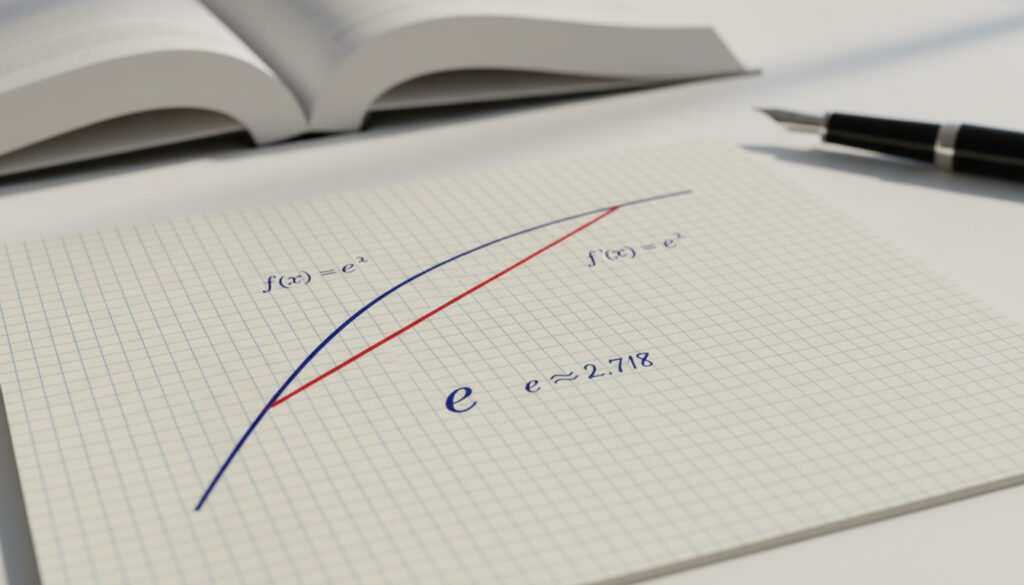
The derivative of f(x) = ex is f'(x) = ex. This means the slope of the tangent line at any point on the curve y = ex equals the y-coordinate of that point. At x = 0, where ex = 1, the instantaneous rate of change is also 1, creating a 45-degree tangent line.
- Self-Referential Rate: No other elementary function maintains identical form under differentiation.
- Unit Slope at Origin: At x = 0, the derivative equals 1, defining the base e uniquely among all positive real numbers.
- Operational Invariance: The nth derivative remains ex for any positive integer n.
- Integral Duality: The antiderivative of ex is also ex (plus constant C).
- Series Preservation: Term-by-term differentiation of the Taylor series Σ xn/n! yields the same series.
- Modeling Foundation: Solutions to differential equations y’ = ky rely fundamentally on this derivative property.
| Property | Value/Expression |
|---|---|
| First Derivative | d/dx ex = ex |
| Value at x = 0 | 1 |
| Slope at x = 0 | 1 |
| n-th Derivative | dn/dxn ex = ex |
| Indefinite Integral | ∫ ex dx = ex + C |
| Taylor Series | Σn=0∞ xn/n! |
| Domain | All real numbers (-∞, ∞) |
| Range | (0, ∞) |
Why is the derivative of ex equal to ex?
The equality stems from how mathematicians defined the number e. Specifically, e is the unique real number such that the limit limh→0 (eh – 1)/h equals exactly 1. This definition ensures that when applying the limit definition of the derivative, the scaling factor simplifies to unity, leaving the original function unchanged.
The Defining Limit Property
For any exponential function ax, the derivative involves the limit limh→0 (ah – 1)/h = ln(a). Khan Academy demonstrates that only when a = e does ln(e) = 1, causing the derivative to equal the function itself rather than a scaled version.
The Unique Base e
Alternative bases require adjustment factors. For example, the derivative of 2x equals 2x · ln(2), introducing a constant multiplier approximately equal to 0.693. The base e eliminates this complication, making it the natural choice for calculus operations and exponential modeling.
The limit limh→0 (eh – 1)/h = 1 is not derived from the derivative of ex; rather, it is the defining property that establishes e. This circularity is resolved by defining e as limn→∞ (1 + 1/n)n, then proving the limit equals 1 through analysis of compound interest.
How do you prove the derivative of ex is ex?
Multiple analytical approaches confirm the derivative of ex. Each method—limit definition, implicit differentiation, and chain rule verification—illuminates different aspects of the function’s structure while arriving at the identical result.
First Principles Derivation
Using the limit definition f'(x) = limh→0 [f(x+h) – f(x)]/h, substitute ex:
limh→0 [ex+h – ex]/h = limh→0 ex(eh – 1)/h = ex · limh→0 (eh – 1)/h.
Since limh→0 (eh – 1)/h = 1 by definition of e, the result simplifies to ex. AnalyzeMath provides a step-by-step visualization of this algebraic manipulation.
Implicit Differentiation Approach
Consider y = ex. Taking natural logarithms yields ln(y) = x. Differentiating both sides with respect to x gives (1/y) · dy/dx = 1, therefore dy/dx = y = ex. ProofWiki documents this formal derivation in detail.
Verification via Chain Rule
For the composite function eu(x), the chain rule states the derivative equals eu(x) · u'(x). When u(x) = x, then u'(x) = 1, reducing the expression to ex. This confirms consistency with the general rule for exponential derivatives while validating the simpler result.
What is the derivative of e−x or ekx?
Variations of the exponential function follow predictable patterns based on the chain rule and constant multiplication rules. These extensions demonstrate the flexibility of exponential calculus while highlighting why the base e remains fundamental across transformations.
For ekx, where k is any constant, the derivative equals k·ekx. The constant k emerges from the derivative of the inner function kx.
Scalar Multiples in the Exponent
The function e−x differentiates to −e−x, reflecting the derivative of −x being −1. Similarly, e2x yields 2e2x, demonstrating direct proportionality between the coefficient and the resulting derivative. Cuemath details these scalar variations with worked examples and graphical interpretations.
For ax where a ≠ e, always rewrite as ex·ln(a) before differentiating. The result is ax · ln(a), with ln(a) serving as the correction factor missing from base e.
General Exponential Bases
Arbitrary positive bases a require logarithmic conversion. Since ax = ex·ln(a), applying the chain rule yields d/dx [ax] = ex·ln(a) · ln(a) = ax ln(a). Only when a = e does ln(a) = 1, simplifying to the self-derivative property. Video demonstrations illustrate this comparison graphically, showing how other bases produce scaled derivatives.
How did the derivative of ex develop historically?
The mathematical understanding of exponential derivatives emerged gradually through investigations of compound interest and logarithmic relationships during the Scientific Revolution.
- : Jacob Bernoulli studies compound interest, approximating the constant e through limn→∞ (1 + 1/n)n while working on continuous growth problems.
- : Isaac Newton and Gottfried Wilhelm Leibniz formalize calculus, developing the limit definitions and fluxion methods necessary for proving exponential derivatives.
- : Leonhard Euler publishes Introductio in analysin infinitorum, defining e ≈ 2.71828 and establishing the series expansion ex = Σ xn/n!, proving the function equals its own derivative through term-by-term differentiation.
- : Augustin-Louis Cauchy and Karl Weierstrass rigorize the epsilon-delta limit definitions, placing the derivative of ex on firm logical foundations independent of geometric intuition.
- : The function becomes central to differential equations, quantum mechanics, and probability theory, with applications extending to modern machine learning activation functions.
Historical expositions trace these developments through original texts and modern interpretations.
What is definitively established about the derivative of ex?
While the derivative of ex constitutes settled mathematical knowledge, distinguishing between established theorems and contextual limitations remains important for proper application across different mathematical domains.
| Established Facts | Contextual Limitations |
|---|---|
| The limit limh→0 (eh – 1)/h = 1 defines e uniquely among real numbers. | Complex analysis extends the definition to imaginary exponents, requiring Euler’s formula eix = cos(x) + i·sin(x), where the derivative relationship holds but involves complex arithmetic. |
| d/dx ex = ex holds for all real x. | Non-standard analysis approaches using infinitesimals provide alternative proofs not covered in standard calculus curricula. |
| The nth derivative equals ex for any positive integer n. | Discrete analogs (difference equations) use q-analogues where the simple self-derivative property does not apply. |
| Taylor series differentiation confirms the result term-by-term. | p-adic analysis defines exponential functions differently, altering derivative properties in non-Archimedean contexts. |
Why does the derivative of ex matter in context?
The Fallen Angel Painting – Cabanel’s History and Symbolism demonstrates how mathematical concepts permeate diverse fields, much as exponential functions underpin modern scientific modeling across disparate disciplines.
The self-derivative property enables solutions to differential equations of the form y’ = ky, describing radioactive decay, population dynamics, and continuously compounded interest. In physics, wave functions in quantum mechanics and heat diffusion equations rely on exponential solutions. The function’s graph, where slope equals height, provides visual intuition for proportional growth rates that remain constant regardless of scale.
University of Texas course materials detail applications in natural phenomena, emphasizing how the derivative’s simplicity enables modeling of complex systems. Machine learning algorithms utilize softmax functions (normalized exponentials) for probability distributions, while financial mathematics employs ert for continuous growth calculations where the derivative represents instantaneous return rates.
What do authoritative sources say about the derivative of ex?
The derivative of ex is one of the most important results in calculus, precisely because the function is its own derivative. This property makes it the natural base for exponential functions and logarithms.
— Standard Calculus Curriculum, Khan Academy
At x = 0, the slope of the tangent line to y = ex is exactly 1. This geometric property uniquely determines the number e among all possible bases, establishing the fundamental constant of calculus.
— Mathematical Analysis Video Series
What should you remember about the derivative of ex?
The derivative of ex equals ex uniquely among exponential functions, arising from the limit definition that establishes e ≈ 2.718. This property, proven through first principles, implicit differentiation, and the chain rule, enables solutions to differential equations and models of continuous change across physics, biology, and economics. What Is Sugar Alcohol – Benefits, Risks and Uses
Frequently Asked Questions
What is the general rule for derivatives of exponential functions?
For any base a > 0, d/dx [ax] = ax · ln(a). Only base e eliminates the ln(a) factor since ln(e) = 1.
How do you compute the derivative of ekx?
Apply the chain rule: d/dx [ekx] = ekx · k, where k is any constant.
What is the nth derivative of ex?
The nth derivative equals ex for any positive integer n, maintaining the original function through repeated differentiation.
How does the derivative of ex differ from polynomials?
Polynomial derivatives reduce degree (xn becomes nxn-1), eventually reaching zero. The exponential derivative preserves the function indefinitely.
Why is e the only base with this property?
The limit limh→0 (ah-1)/h equals ln(a), which is 1 only when a = e. All other bases introduce multiplicative constants.
What happens to the derivative at x = 0?
At x = 0, ex = 1 and the derivative equals 1, making the tangent line’s slope exactly 45 degrees.
More related posts
 Portrait of a Lady on Fire: Complete Guide & Top Questions
 How Old Is Beyoncé? Real Name, Age, Kids, Net Worth
 Molly Ringwald Movies & TV Shows: Complete List
 Auburn vs Texas A&M – Final Score, Stats & Recap
 When Was Hurricane Katrina? Date, Death Toll, and Facts
 How to Improve Gut Health: 5 Evidence-Backed Steps
 Books by Charlie Kirk: Complete List and Order
 What Does Prednisone Do? Uses, Side Effects & Safety