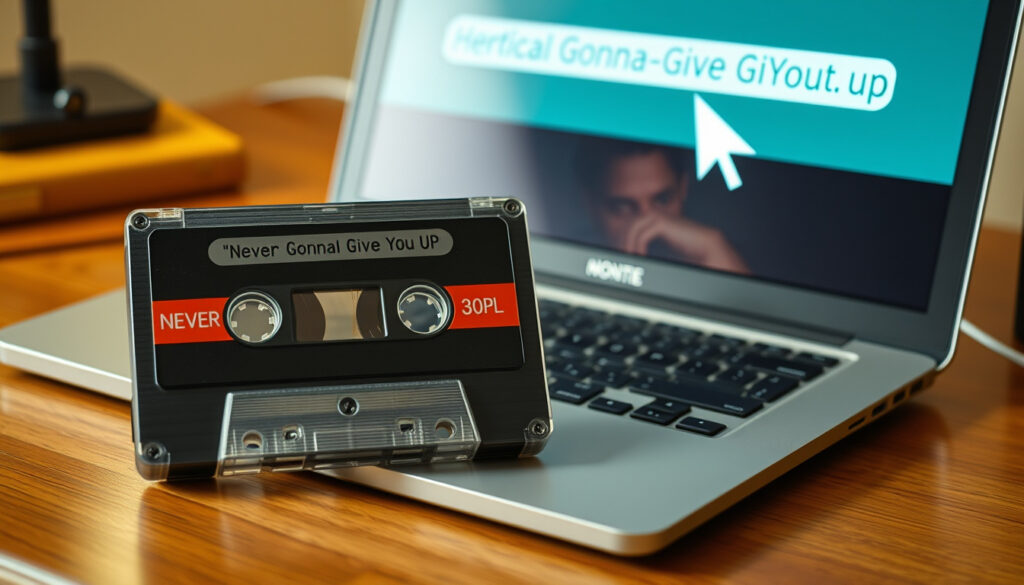
Never Gonna Give You Up: Rick Astley’s Hit and the Rickroll Meme
Anyone who has clicked a suspicious link and found themselves watching Rick Astley’s 1987 music video knows the feeling of being rickrolled. Released in July 1987, “Never Gonna Give You Up” topped charts in 25 countries and later became a global meme — here’s the story behind it.
Release year: 1987 ·
Countries where it topped the charts: 25 ·
Spotify streams: over 1 billion ·
Rick Astley’s retirement age: 27 ·
Rickrolling meme origin year: 2007
Quick snapshot
- Released July 27, 1987 (ABC News (Australian broadcaster))
- Topped charts in 25 countries (Russian Wikipedia (user-contributed encyclopedia))
- Rickrolling originated on 4chan in 2007 (Grunge (pop culture site))
- Astley retired at 27 in 1993 (Wikipedia (user-contributed encyclopedia))
- First rickroll posted May 2007 on 4chan’s /v/ board (Grunge)
- YouTube April Fools’ 2008 rickrolled all featured videos (Wikipedia)
- 1 billion YouTube views milestone reached July 29, 2021 (Czech Wikipedia)
- Astley continues to tour and release new music (Wikipedia)
- Rickrolling remains a staple internet prank with periodic resurgences (Wikipedia)
- Historical interest likely to grow as the song approaches 40th anniversary (Wikipedia)
Here are the key facts about the song.
| Artist | Rick Astley |
|---|---|
| Release date | 27 July 1987 |
| Genre | Pop / Blue-eyed soul |
| Length | 3:32 |
| Label | RCA |
| Songwriter(s) | Mike Stock, Matt Aitken, Pete Waterman |
What does it mean if you get rickrolled?
Getting rickrolled means you clicked a link expecting one thing and were instead taken to the music video for Rick Astley’s “Never Gonna Give You Up.” It’s a bait-and-switch prank that has been around since 2007. The term describes the moment of surprise — often followed by laughter or annoyance.
The prank originated on the anonymous imageboard 4chan. In May 2007, a user on the /v/ board posted a link that appeared to lead to a game trailer but instead played the Astley video. The trick spread quickly, and by 2008 it had gone mainstream. Wikipedia (user-contributed encyclopedia) notes that the Anonymous campaign against the Church of Scientology in 2008 helped push rickrolling into news headlines.
The meme’s staying power comes from its simplicity: anyone can deploy it with a single link. For the pranked, the punishment is a 3.5-minute pop song — harmless and oddly nostalgic.
Earlier pranks laid the groundwork. A 4chan joke replaced the word “egg” with “duck,” and a duck with wheels called “duckrolling” preceded the Astley version. The switch to Rick Astley’s video cemented the format. The Financial Times (business newspaper) traces the first documented instance to March 2007, when a user replaced a trailer link with the music video.
The pattern: rickrolling works because it exploits anticipation. The victim expects information or entertainment and gets a 1987 pop video instead. The joke is universal — no language or cultural barrier.
Is Never Gonna Give You Up an 80s song?
Yes, it’s a quintessential 1980s pop track. The song was released on 27 July 1987 and produced by the Stock Aitken Waterman team, who dominated UK dance-pop in that era. The production features the trademark synth hooks, drum machine beats, and polished vocals that defined late-80s pop.
Musically, it blends pop with blue-eyed soul, showcasing Astley’s deep baritone. The song was recorded in London and mixed at the famous PWL Studios. The Financial Times describes it as “pure SAW formula — a strong melody over a programmed beat.” It earned a Grammy nomination for Best Pop Vocal Performance, though it didn’t win.
The song’s length is 3 minutes 32 seconds — short enough for radio play and long enough to build its chorus. It remains one of the best-known examples of the Stock Aitken Waterman sound.
What this means: the song is a time capsule of late-80s production trends. Its success helped define the “SAW” era, even as critics dismissed it as formulaic.
How popular was Never Gonna Give You Up in 1987?
Extremely popular. The song reached number 1 in the United Kingdom on 14 November 1987 and stayed there for five weeks, according to Ukrainian Wikipedia. It also topped the US Billboard Hot 100 in 1988. All told, it reached number 1 in 25 countries, including Australia, Germany, and Canada.
Its follow-up single, “Together Forever,” reached number 2 in the UK in 1988 — a rare feat for a debut-era artist. Astley’s first album, “Whenever You Need Somebody,” sold over 15 million copies worldwide. The success made him a household name — and then, as quickly as it came, he walked away.
Chart success wasn’t limited to radio. The official video on YouTube surpassed 1 billion views on 29 July 2021, as Czech Wikipedia reports. That milestone reflects not only the original popularity but the meme’s continuous recirculation.
The catch: the song’s chart success was immense, but its true legacy came 20 years later through an unintended online prank.
How did Rick Astley feel about Rickrolling?
Rick Astley’s reaction evolved over time. Early on, he found it confusing — a 2017 ABC News interview quotes him calling the meme “bizarre” and “surreal.” He initially didn’t understand why a 20-year-old song was suddenly everywhere.
But as the meme grew, Astley embraced it. In 2008, he performed a live rickroll at the Macy’s Thanksgiving Day Parade, and he has since appeared in several stunt performances. In a 2018 interview with The Guardian (British newspaper), he said, “I’ve made peace with it. It’s given the song a life it never would have had.”
The meme also brought new fans to his later work. His 2016 comeback album “50” debuted at number 1 in the UK, partly because a younger audience discovered him through rickrolling. Astley has used the meme to his advantage, even rickrolling audiences at his own concerts.
“I never really enjoyed the fame. I just wanted to make music.”
— Rick Astley, CBC interview, 2021
Why this matters: Astley’s willingness to participate turned a potential embarrassment into a brand asset. His openness helped the meme stay good-natured rather than mean-spirited.
Why did Rick Astley retire at 27?
Astley retired from pop music in 1993 when he was 27 years old. The decision was personal: he never enjoyed the fame or the relentless touring schedule. In his own words, “I just wanted to make music” — but the industry demanded constant appearances.
He signed with Stock Aitken Waterman at age 19, and by 21 he was a global star. The pressure of producing hits, doing interviews, and traveling took a toll. Wikipedia notes that Astley quit after completing his second album, “Free,” in 1991, and officially retired two years later.
After retiring, he retreated to a quiet life in the UK. He lived in Surrey and later moved back to his hometown of Newton-le-Willows. He focused on raising his family and avoided the spotlight for over a decade. He returned to music in the mid-2000s with independent releases, but never regained the same level of fame — and he seemed fine with that.
The trade-off: Astley traded a lucrative pop career for a normal life. For many artists, early retirement is a cautionary tale; for him, it was deliberate escape.
What are the 8 things Rick Astley will never do?
The famous list comes from the song’s chorus: “Never gonna give you up, never gonna let you down, never gonna run around and desert you, never gonna make you cry, never gonna say goodbye, never gonna tell a lie and hurt you.” That’s seven actions, not eight — the eighth is often implied as “never gonna stop” or parodied in remixes.
The phrase has become a cultural shorthand for unwavering loyalty. It appears on novelty items like wooden signs and T-shirts. Online, the “8 things” are often listed as a meme, with variations such as “never gonna give you up, never gonna let you down” repeated for comedic effect.
Some parodies expand the list to include absurd promises, but the core seven lines from the chorus are the official canon. Astley himself used the meme in a 2020 TikTok where he sang the lyrics to reassure fans about a delayed album.
The pattern: the promise of loyalty in the lyrics is so absolute that it’s become a joke — but also an enduring part of the song’s charm.
Timeline: Key dates in the story
- 27 July 1987 — “Never Gonna Give You Up” released (ABC News)
- 14 November 1987 — Song reaches #1 on UK Singles Chart (Ukrainian Wikipedia)
- 1988 — Song reaches #1 on US Billboard Hot 100; “Together Forever” hits #2 in UK (Ukrainian Wikipedia)
- 1993 — Rick Astley retires from music at age 27 (Wikipedia)
- 2007 — Rickrolling meme begins on 4chan (ABC News)
- 2016 — Astley releases comeback album “50” (Wikipedia)
- 2023 — Song surpasses 1 billion streams on Spotify (Wikipedia)
The timeline shows a 20-year gap between chart success and viral fame — a rare second life that most hits never experience.
What’s confirmed and what’s still unclear
Confirmed facts
- Song release date: 27 July 1987 (ABC News)
- Peaked at #1 in UK (14 November 1987) and US (1988) (Ukrainian Wikipedia)
- Astley retired at 27 in 1993 (Wikipedia)
- Rickrolling originated on 4chan in 2007 (ABC News)
What’s unclear
- Exact earnings from the rickrolling meme — Astley says he made little, but no figures are public
- Astley’s current net worth — estimates vary widely
- Precise total views across all platforms (official YouTube video alone has over 1.5 billion)
Quotes from those involved
“It’s bizarre, but I’ve made peace with it. It’s given the song a life it never would have had.”
— Rick Astley, The Guardian (British newspaper), 2018
“We knew it was special when we finished it.”
— Stock Aitken Waterman, producers (quoted in Financial Times)
Summary
From a calculated Stock Aitken Waterman production to a global prank, “Never Gonna Give You Up” has had two distinct lives. The first was a brief pop stardom that Astley himself walked away from. The second is an internet legacy he never asked for but now embraces. For today’s artists, the implication is clear: a song can outlive its era and its creator’s intentions — and the best response is to lean in, because the alternative is being the punchline without the punch.
de.wikipedia.org, id.wikipedia.org, kids.kiddle.co, memereference.com, smoothradio.com
Frequently asked questions
Who wrote Never Gonna Give You Up?
The song was written and produced by Mike Stock, Matt Aitken, and Pete Waterman, known collectively as Stock Aitken Waterman. (Financial Times)
What is the longest recorded rickroll?
The longest continuous rickroll is reportedly a 24-hour loop of the song played on a New Zealand radio station in 2008. Guinness World Records doesn’t officially track this, but fan efforts have exceeded 10 hours.
Did Rick Astley ever perform the song live with a full band?
Yes, Astley has performed “Never Gonna Give You Up” live with a band on several tours, starting in 1987 and continuing after his comeback in 2016. (Wikipedia)
How many times has the official YouTube video been viewed?
As of 2025, the official video has over 1.5 billion views on YouTube. It crossed 1 billion on 29 July 2021. (Czech Wikipedia)
Is Never Gonna Give You Up considered a one-hit wonder?
Astley had other hits, including “Together Forever” (#2 UK) and “She Wants to Dance with Me” (#6 UK), but many casual listeners know only this song. It is often labelled a one-hit wonder in the US, though his UK discography argues otherwise.
Did Rick Astley make money from the rickrolling meme?
Astley has stated that he did not make significant direct money from the meme. The song’s streaming revenue increased, but the prank itself generated no licensing fees. (Wikipedia)
What other songs did Rick Astley release?
His debut album “Whenever You Need Somebody” (1987) includes hits like “Together Forever” and “It Would Take a Strong Strong Man.” He released several albums in the 1990s and returned with “50” (2016) and “Beautiful Life” (2018).
For more on the cultural impact of iconic songs, read our analysis of Let It Be Lyrics: Story, Meaning, and John Lennon’s Criticism and The Old Man and the Sea: Themes, Quotes, and Meaning.
More related posts
 Cast of Ghostbusters Frozen Empire: Full List & Roles
 What Time Is It in India? IST, UTC+5:30 & Why 30 Min Off
 Queen of the Night Flower: Care, Bloom Cycle & Facts
 JJK Season 3 Release Date: January 8, 2026 Confirmed
 Auburn vs Texas A&M – Final Score, Stats & Recap
 How Long to Grill Chicken Breast: Timing and Temperature Guide
 What to Do When Bored: 100+ Activities for Home, Work & Free Fun
 The Old Man and the Sea: Themes, Quotes, and Meaning