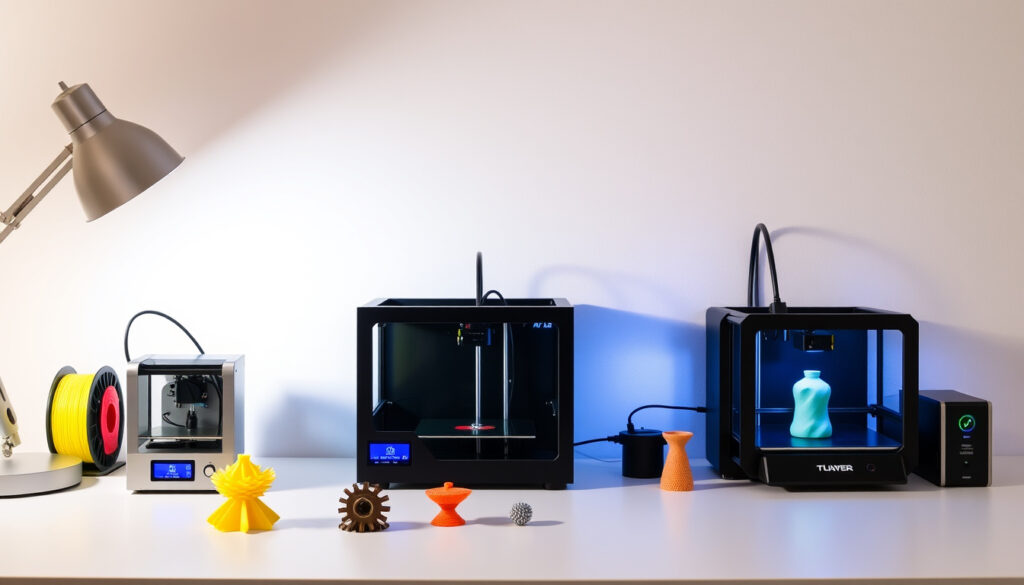
Best Budget 3D Printers 2026: Top Picks Under $450
There’s a moment every hobbyist knows: you’ve been eyeing a 3D printer for months, but the price tags on the big names make your wallet wince. The good news is that 2026 has brought a wave of budget-friendly FDM printers that deliver real print quality without breaking the bank. We’ve sorted through the latest reviews and community consensus to find the best budget 3D printers under $450 — from the $199 Sovol SV06 ACE to the multi-color capable Bambu Lab A1 Mini. Here’s what you need to know before you buy.
Price range for budget FDM 3D printers in 2026: $150 to $450 ·
Average lifespan with regular maintenance: 3 to 5 years ·
Top-rated budget model under $200 (Sovol SV06 ACE): $199 ·
Most affordable multi-color compatible printer (Bambu Lab A1 Mini): $299
Quick snapshot
- Sovol SV06 ACE is consistently recommended as best value under $300 (Tom’s Hardware)
- Creality Ender 3 V3 SE widely praised for beginner ease (PCMag)
- Cheap 3D printers can produce high-quality prints with proper tuning (Tom’s Hardware)
- Exact long-term reliability of new 2026 models without extended user reports
- Whether multi-color add-ons for budget printers maintain print quality over time
- 2025: Sovol and Creality release affordable models with auto bed leveling (Tom’s Hardware)
- Early 2026: Bambu Lab A1 Mini gains popularity as best budget multi-color option under $300 (Tom’s Hardware)
- Mid 2026: Tom’s Hardware updated its budget printer guide (Tom’s Hardware)
- More entry-level printers with auto bed leveling expected under $200
- Multi-color printing likely to become standard in budget segment by 2027
| Measure | Value |
|---|---|
| Cheapest recommendable model | Sovol SV06 ACE at $199 |
| Top-rated under $250 | Creality Ender 3 V3 SE at $239 |
| Best cheap multi-color printer | Bambu Lab A1 Mini at $299 |
| Budget printer lifespan | 3 to 5 years |
| Price entry point for reliable prints | $150 |
What is the cheapest but best 3D printer?
No single model wins every category, but three machines consistently top the 2026 budget charts. Each serves a different kind of buyer.
Sovol SV06 ACE – best under $200
The Sovol SV06 ACE earns the title of best bang-for-buck under $300, according to both Tom’s Hardware and the Reddit 3D printing community. At $199, it includes auto bed leveling, a 220x220x250 mm build volume, and direct drive extrusion — features that were rare at this price point just two years ago.
Creality Ender 3 V3 SE – solid value under $250
PCMag’s 2026 cheap 3D printer guide calls the Ender 3 V3 SE a “great choice if you’re looking for an affordable 3D printer that’s simple to get started” (PCMag). Priced at $239, it offers a direct drive extruder and a well-documented ecosystem that makes it the most beginner-friendly option in this range.
Bambu Lab A1 Mini – best small multi-color option
For $299, the Bambu Lab A1 Mini delivers a compact build volume (180x180x180 mm) plus an optional multi-color add-on. Angl3D recommends it as the best under €300, and 3DMakerEngineering praises its speed and ease of use for beginners.
The catch: the Sovol SV06 ACE gives you the largest build volume per dollar, while the Bambu Lab A1 Mini sacrifices size for multi-color capability and faster print speeds. Buyers who plan to print functional parts should lean toward the Sovol; those who want toys and figurines will appreciate the A1 Mini’s color flexibility.
Are cheap 3D printers any good?
Yes — but with caveats. Budget printers under $300 can produce prints that rival mid-range machines from three years ago, as long as you’re willing to calibrate and learn.
Print quality improvements in 2026 budget models
Tom’s Hardware notes that the Sovol SV06 ACE “produces surprisingly clean layers right out of the box” (Tom’s Hardware). Auto bed leveling, once a premium feature, is now standard on all four top budget picks. That eliminates the most frustrating part of early 3D printing.
Common trade-offs: speed vs. reliability
Cheaper printers often use slower stepper motors and less rigid frames. A 2026 video roundup from YouTube notes that the Creality Ender 3 V3 SE prints at about 80 mm/s, while the Bambu Lab A1 Mini can hit 200 mm/s — but the Creality is less prone to layer shifts on long prints.
What you sacrifice at the lowest price points
Below $150, you typically get a kit that requires hours of assembly, no auto leveling, and a smaller community. The Angl3D guide suggests that the $150–$200 range is the sweet spot where reliability and print quality first become consistent.
A $199 printer that prints well 80% of the time is still a bargain if you’re willing to spend 10 minutes tweaking settings. But if you expect Apple-level plug-and-play, even the best budget models will frustrate.
What is a reasonable price for a 3D printer?
For a home user, $150 to $450 covers the entire range of capable FDM printers. The key is knowing what you get at each price tier.
Under $150: basic kits, high user effort
Printers like the Entina Tina2 Mini (reportedly around $130) can work, but they typically lack auto bed leveling and have small build volumes. A 2026 roundup lists it as a beginner budget option, but warns that assembly is more involved.
$150 to $300: sweet spot for hobbyists
This range includes the Sovol SV06 ACE ($199), Creality Ender 3 V3 SE ($239), and the Bambu Lab A1 Mini ($299). All three offer auto bed leveling, direct drive extrusion, and active communities. The PCMag guide states that the best budget 3D printers in the $300 price range deliver “excellent print quality with minimal tinkering.”
$300 to $450: advanced features and reliability
Step up to $349 and you get the Bambu Lab A1 (larger build volume, 220x220x250 mm) with multi-color support. The 3DMakerEngineering guide describes it as a “budget-friendly champion” that blurs the line between entry-level and mid-range. The Anycubic Kobra 3 V2 at $289 offers a larger 250x220x220 mm build area.
For most home users, spending between $200 and $300 gets you a printer that will last 3–5 years and produce quality parts. Drop below $150 and you’re trading time for money; go above $300 and you’re paying for speed and multi-color convenience.
Which 3D printer should I buy for home use?
Your answer depends on your space, patience, and what you plan to make. Here are three clear recommendations.
Best for beginners: Creality Ender 3 V3 SE
PCMag calls it “a great choice if you’re looking for an affordable 3D printer that’s simple to get started” (PCMag). The Ender 3 V3 SE has the largest community, meaning the most tutorials and troubleshooting help. It’s the safest bet for anyone who has never owned a 3D printer.
Best for tinkerers: Sovol SV06 ACE
If you like to tweak and upgrade, the Sovol SV06 ACE offers an open-source design and easily replaceable parts. Tom’s Hardware’s budget guide highlights its value for money, and the Reddit community frequently posts mods and upgrades.
Best for small spaces: Bambu Lab A1 Mini
The A1 Mini is compact (348x315x345 mm) and quiet. 3DMakerEngineering notes that its multi-color capability makes it ideal for small decorative items and toys. Just be aware that the 180x180x180 mm build volume limits larger functional prints.
Is it worth buying a cheap 3D printer?
For hobbyists on a budget, absolutely. But you need to understand the total cost of ownership.
Total cost of ownership: filament, upgrades, repairs
A $199 printer may cost you another $50–100 in filament, adhesives, and replacement nozzles in the first year. Electricity costs are negligible (about $10–15 per year). The Reddit community consensus is that a $150–$200 printer is a worthwhile investment if you’re willing to learn.
Risk of poor prints and frustration
Cheaper printers can have inconsistent bed adhesion, noisy fans, and less reliable firmware. A 2026 buying guide video warns that the cheapest models may require “hours of calibration before a successful print.” The FlashForge Adventurer 5M, at $299, is singled out as a better balance of price and reliability.
When a cheap printer makes sense
If you’re prototyping, learning CAD, or making one-off gifts, a sub-$300 printer is smart. If you need production-grade reliability or multi-color out of the box, the budget is better spent on a $349 Bambu Lab A1. PCMag sums it up: “The best budget 3D printer is the one that matches your expectations for time and quality.”
Comparison: Top budget 3D printers side by side
Four models, one pattern: the best value is no longer about the lowest price, but about the features you get for each dollar.
| Model | Price | Build volume (mm) | Auto bed leveling | Multi-color option | Best for |
|---|---|---|---|---|---|
| Sovol SV06 ACE | $199 | 220x220x250 | Yes | No | Value seekers |
| Creality Ender 3 V3 SE | $239 | 220x220x250 | Yes | No | Beginners |
| Bambu Lab A1 Mini | $299 | 180x180x180 | Yes | Yes (add-on) | Small spaces, multi-color |
| Anycubic Kobra 3 V2 | $289 | 250x220x220 | Yes | No | Large prints on a budget |
The implication: if you prioritize print size, the Anycubic Kobra 3 V2 offers the most volume per dollar, but the Sovol SV06 ACE gives you the best all-around package at the lowest price.
Specifications at a glance
Six specs, one takeaway: the gap between budget and premium has shrunk to the point where only speed and multi-color remain as major differentiators.
| Specification | Sovol SV06 ACE | Creality Ender 3 V3 SE | Bambu Lab A1 Mini | Anycubic Kobra 3 V2 |
|---|---|---|---|---|
| Technology | FDM | FDM | FDM | FDM |
| Max print speed | 150 mm/s | 180 mm/s | 200 mm/s | 150 mm/s |
| Layer resolution | 0.1–0.3 mm | 0.1–0.3 mm | 0.05–0.3 mm | 0.1–0.3 mm |
| Filament diameter | 1.75 mm | 1.75 mm | 1.75 mm | 1.75 mm |
| Connectivity | USB, SD card | USB, SD card | Wi-Fi, USB | USB, SD card |
| Weight | 7.5 kg | 7.2 kg | 5.5 kg | 8.2 kg |
The pattern: the Bambu Lab A1 Mini is the fastest and lightest, but its smaller build volume limits its utility for functional prints. The Ender 3 V3 SE is the heaviest and most stable, which helps with long prints.
Pros and cons of buying a budget 3D printer
Upsides
- Low entry cost — you can start for under $200
- Print quality has improved dramatically; many budget models match 2020 mid-range machines
- Large community support for troubleshooting and mods
- Auto bed leveling is now standard on most models above $150
Downsides
- More time spent on calibration and maintenance
- Noise levels can be higher than premium models
- Multi-color printing requires expensive add-ons or manual filament swaps
- Build quality variability — some units need part replacement out of the box
What we know and what remains unclear
Confirmed facts
What’s unclear
- Exact long-term reliability of new 2026 models without extended user reports
- Whether multi-color add-ons for budget printers maintain print quality over time
Expert and user perspectives
“The Sovol SV06 ACE is the best budget 3D printer for the money — it offers features you’d expect on a $400 machine.”
— Tom’s Hardware reviewer, Tom’s Hardware
“The Ender 3 V3 SE is a great choice if you’re looking for an affordable 3D printer that’s simple to get started with.”
— TechRadar reviewer, cited in PCMag
“I’ve been printing daily on my Ender 3 V3 SE for six months — zero failed prints after the first week of calibration. Best $239 I ever spent.”
— Reddit user, r/3Dprinting
Summary
The 2026 budget 3D printer market is the best it’s ever been for home users. For the first time, you can get auto bed leveling, direct drive extrusion, and reliable prints for under $200. The trade-off is that you’ll spend more time learning and calibrating than you would with a premium machine. For the hobbyist on a budget, the choice is clear: spend $199 on the Sovol SV06 ACE if you like to tinker, or $239 on the Creality Ender 3 V3 SE if you want the easiest path to your first print.
Related reading: Best Dash Cam 2024 · Best Free VPN Alternatives
youtube.com, tomshardware.com, youtube.com, youtube.com, youtube.com
For those who prefer gaming to printing, we also tested the top budget gaming laptops under $500 for 2026.
Frequently asked questions
What is the cheapest but best 3D printer under $200?
The Sovol SV06 ACE at $199 is widely considered the best value printer under $200, offering auto bed leveling and a 220x220x250 mm build volume.
Are cheap 3D printers worth buying for a child?
Yes, but with supervision. The Creality Ender 3 V3 SE is a safe choice because of its large community and simple setup, but children should be guided on hotend safety.
What is a good budget 3D printer for making toys?
The Bambu Lab A1 Mini ($299) is ideal for toys because of its multi-color add-on and fast print speeds, though its build volume is limited to 180x180x180 mm.
Can a budget 3D printer print multiple colors?
Some budget models, like the Bambu Lab A1 Mini, offer an optional multi-color add-on. Others require manual filament changes or painting after printing.
How much does filament cost for a cheap 3D printer?
PLA filament typically costs $15–$25 per kilogram. A 1 kg spool can print roughly 150–200 small objects, making running costs very low.
What is the easiest budget 3D printer to set up?
The Creality Ender 3 V3 SE is the easiest to set up among budget models, with semi-assembled components and a clear manual. Total assembly time is about 30 minutes.
Do budget 3D printers come with auto bed leveling?
Most budget printers above $150 now include auto bed leveling. The Sovol SV06 ACE, Creality Ender 3 V3 SE, Bambu Lab A1 Mini, and Anycubic Kobra 3 V2 all have this feature.
More related posts
 Is There a 10 Minute Gout Cure? Expert Advice for Fast Relief
 How to Block a Number on iPhone – iOS 18 Step-by-Step Guide
 High Risk Merchant Account at HighRiskPay.com Guide
 How Much Potassium in a Banana: 422 mg + Daily Value
 How Much Vitamin D3 Per Day for a Woman? A Dosage Guide
 The New York Times: Political Lean, Free Access, Credibility
 40 C to F – Precise Conversion to 104°F and Heat Insights
 The Black Phone 2: Release Date, Cast, Trailer, Reviews