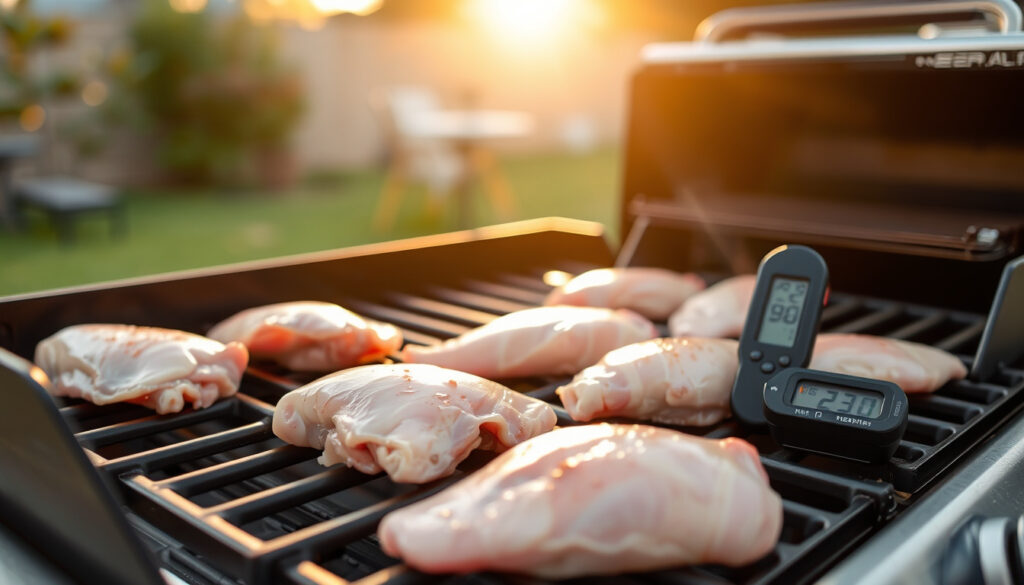
How Long to Grill Chicken Breast: Timing and Temperature Guide
Anyone who’s pulled a chicken breast off the grill only to find it dry, tough, or undercooked knows the frustration—getting the timing right is the difference between a meal that disappoints and one that impresses. The good news: with a few precise temperatures and straightforward techniques, consistently juicy grilled chicken is entirely achievable—and this guide shows you exactly how.
Average grilling time for boneless chicken breast at 400°F: 6-8 minutes per side ·
Safe internal temperature for chicken: 165°F (74°C) ·
Recommended resting time after grilling: 5 minutes ·
Ideal grill temperature range: 375-450°F (190-230°C)
Quick snapshot
- Safe internal temp for chicken is 165°F (FoodSafety.gov, the federal food safety authority)
- Grill at 375-450°F for best results (Weber, the leading grill manufacturer)
- Rest chicken 5 minutes after grilling (Ambitious Kitchen, a popular cooking blog)
- Whether the 3-3-3 rule (originally for steak) works well for chicken breasts
- Exact timing varies by thickness, grill model, and ambient temperature
- Bring chicken to room temp: 15-20 min (Ambitious Kitchen, a popular cooking blog)
- Grill at 400°F: 6-8 min per side (Ambitious Kitchen, a popular cooking blog)
- Rest covered: 5 min (Ambitious Kitchen, a popular cooking blog)
- Use a meat thermometer for precision (What Molly Made, a trusted recipe resource)
- Pull chicken at 160°F, let carryover cooking reach 165°F (What Molly Made, a trusted recipe resource)
Five key data points, one pattern: thickness and temperature dictate timing more than any single rule. Here is the reference table for quick decision-making.
| Attribute | Value | Source |
|---|---|---|
| Average time per side (boneless, 1-inch) | 6-8 minutes | Springer Mountain Farms, a poultry producer |
| Safe internal temperature | 165°F (74°C) | FoodSafety.gov, the federal food safety authority |
| Ideal grill temperature | 375-450°F (190-230°C) | Weber, the leading grill manufacturer |
| Resting time | 5 minutes | Ambitious Kitchen, a popular cooking blog |
| Flip frequency recommendation | Once | National Chicken Council, the industry trade association |
How to grill a chicken breast without drying it out?
Dry chicken is almost always a temperature problem, not a timing problem. The solution: control the heat, use a thermometer, and let the meat rest.
Marinating for moisture
- Marinate at least 30 minutes for flavor and moisture; Weber (the leading grill manufacturer) recommends up to overnight for fuller flavor.
- Acidic ingredients (citrus, vinegar) in marinades help tenderize the surface, but avoid over-marinating beyond 12 hours or the texture can turn mushy.
- Oil-based marinades help prevent sticking and promote even browning.
Brining basics
- A quick brine—salt dissolved in water—for 15-30 minutes improves moisture retention by helping muscle fibers hold onto water during cooking.
- Dry brining (rubbing salt directly on the skin or meat) works too: apply salt 30-60 minutes before grilling and refrigerate uncovered.
- Brining is especially effective for boneless breasts that tend to dry out faster than bone-in cuts.
Using a meat thermometer
- The most reliable way to avoid dry chicken: use an instant-read thermometer. What Molly Made (a trusted recipe resource) advises cooking until the thickest part reaches 160°F, then letting carryover cooking bring it to 165°F during rest.
- Insert the probe sideways from the thickest edge—avoiding bone—for the most accurate reading.
Resting the chicken
- Rest covered with foil for 5 minutes after grilling. Ambitious Kitchen (a popular cooking blog) specifically recommends 5-10 minutes of covered rest before slicing.
- Resting allows juices to redistribute evenly rather than running out onto the cutting board.
How often should I flip the chicken on the grill?
Single flip vs multiple flips
- Flip only once for best grill marks and even cooking. Weber (the grill manufacturer’s guide) says chicken breasts generally grill for about 9-10 minutes total, flipping halfway through.
- Flipping repeatedly disrupts the searing process and can cause the exterior to cook faster than the interior.
When to flip based on grill marks
- Wait until the chicken releases easily from the grates—usually after 5-6 minutes on the first side. If it sticks, it’s not ready to flip.
- Well-defined grill marks typically appear at the 5-minute mark on a properly preheated grill at 400°F.
Tips for even cooking
- Pound thick breasts to an even ½-inch thickness before grilling for consistent cook times.
- Keep the grill lid closed while cooking. Ambitious Kitchen (their how-to guide) emphasizes closing the lid to prevent heat loss and ensure even cooking.
- Arrange chicken so pieces are not touching—overcrowding lowers the effective grill temperature.
Flipping more than once is fine if your grill has hot spots and you need to rotate for even cooking. The single-flip rule is a guideline, not a law—but every extra flip costs you surface temperature.
How long to cook chicken on a gas grill at 400 degrees?
Standard boneless breast timing
- Boneless skinless breast (1-inch thick): 6-8 minutes per side at 400°F. Springer Mountain Farms (a poultry producer) confirms this range at 400-450°F.
- The National Chicken Council (the industry trade association) says skinless boneless breasts cook over medium heat for about 10-15 minutes total, reaching 165°F.
Thick breast adjustments
- Thick breast (1.5 inches+): 8-10 minutes per side at 400°F. Reduce heat slightly if the exterior browns too fast before the center cooks through.
- For very thick breasts, use indirect heat after searing: sear 3-4 minutes per side over direct heat, then move to the cooler side of the grill and finish with the lid closed.
Using a thermometer for doneness
- Insert an instant-read thermometer into the thickest part of the breast. The USDA safe minimum is 165°F (FoodSafety.gov, the federal food safety authority).
- What Molly Made (their detailed guide) recommends pulling the chicken at 160°F and letting it coast to 165°F during the rest period—this prevents overcooking.
Temperature conversion: 400°F to Celsius
- 400°F = 204°C. For UK and European readers using Celsius grills, the equivalent medium-high setting is roughly 200-210°C.
- Grill temperature range in Celsius: 375-450°F converts to 190-230°C.
Six timing and temperature combinations, one pattern: thickness and doneness overlap, but a thermometer removes all guesswork.
| Cut & thickness | Grill temp | Time per side | Target internal temp | Source |
|---|---|---|---|---|
| Boneless breast, ½ inch | 400-425°F | 4-5 minutes | 160°F (pull) → 165°F (rest) | What Molly Made, a trusted recipe resource |
| Boneless breast, 1 inch | 375-450°F | 6-8 minutes | 165°F | Springer Mountain Farms, a poultry producer |
| Boneless breast, 1.5+ inches | 375-400°F | 8-10 minutes | 165°F | Ambitious Kitchen, a popular cooking blog |
| Bone-in breast | 375-400°F | 10-12 minutes | 165°F | Springer Mountain Farms, a poultry producer |
| Bone-in breast (sear then indirect) | Medium-high then low | 4 min sear + 18-20 min indirect | 165°F | National Chicken Council, the industry trade association |
| Whole spatchcocked chicken | 375-400°F | 45-60 min total | 165°F (breast) | Springer Mountain Farms, a poultry producer |
What are common mistakes when grilling chicken?
Overcooking and drying out
- Overcooking is the #1 cause of dry chicken. Cooking past 165°F squeezes out moisture as muscle fibers contract and tighten.
- The difference between 165°F and 175°F can mean the loss of up to 30% of the meat’s natural juices.
Starting with cold chicken
- Bring chicken to room temperature for 15-20 minutes before grilling. Cold chicken straight from the fridge causes uneven cooking—the exterior burns before the center reaches 165°F.
- Weber (their grilling basics guide) recommends preheating the grill for 10-15 minutes and cleaning the grates before cooking.
Using too high or too low heat
- Too high (above 500°F): charred exterior, raw center. Too low (below 350°F): chicken steams rather than grills, and the skin turns rubbery.
- The sweet spot is 375-450°F. The National Chicken Council (the industry’s central resource) refers to this as “medium heat.”
Skipping the rest period
- Always rest chicken after grilling. Ambitious Kitchen (their recipe guide) recommends covering grilled chicken with foil and resting for 5-10 minutes before slicing.
- Slicing immediately forces juices to run out; resting lets them redistribute back into the meat fibers.
What is the 3 3 3 rule for grilling?
Explanation of the rule
- The original 3-3-3 rule was developed for steak: 3 minutes per side over high heat, then 3 minutes resting. It produces a medium-rare steak with good sear marks.
- The rule relies on the fact that steak can be safely served below 165°F—chicken cannot, so the timing logic breaks down for poultry.
Adaptation for chicken breasts
- For thin chicken breasts (about ½ inch thick): a 3-3-5 approach works—3 minutes per side over medium-high heat, then 5 minutes resting covered. The rest period allows carryover cooking to bring the internal temperature to 165°F.
- For thicker breasts (1 inch+), 3 minutes per side is not enough. Use the standard 6-8 minutes per side at 400°F instead.
When to use this technique
- The adapted 3-3-5 method works well for thin cutlets or chicken breasts that have been pounded to even thickness. It is not recommended for standard grocery-store breasts that are 1 inch or thicker.
- This is not a standard or widely endorsed rule for chicken—it is a modified technique best reserved for thin cuts where timing is less risky.
The 3-3-3 rule is simple and memorable, but applying it to chicken without adjusting for thickness and doneness temperature is a gamble. A thin cutlet at 3 minutes per side might reach 165°F; a thick breast almost certainly will not.
The implication: the 3-3-3 rule is best left for steak unless you are cooking thin chicken cutlets.
Step-by-Step Guide to Perfect Grilled Chicken
This sequence works for standard 1-inch boneless, skinless chicken breasts on a gas grill at 400°F. Adjust times for thickness using the reference table above.
- Preheat the grill. Turn all burners to medium-high and close the lid. Wait 10-15 minutes until the internal temperature reaches 375-450°F. Weber (their guide) stresses preheating and cleaning the grates before cooking.
- Prep the chicken. Pat dry with paper towels. If marinating, drain excess liquid. If brining, rinse and pat dry. Let sit at room temperature for 15-20 minutes.
- Oil the grates. Dip a folded paper towel in vegetable oil and use tongs to wipe the grates. This prevents sticking and promotes clean grill marks.
- Place chicken on the grill. Arrange breasts in a single layer, not touching. Close the lid. Set a timer for 6 minutes.
- Flip once. After 6 minutes, check for release. If the chicken lifts easily, flip. Cook the second side for 5-6 minutes with the lid closed.
- Check temperature. Insert an instant-read thermometer into the thickest part. Target: 160°F if you plan to rest, or 165°F if serving immediately. What Molly Made (their method) recommends pulling at 160°F for carryover cooking.
- Rest. Transfer chicken to a cutting board, tent loosely with foil, and rest for 5 minutes. Ambitious Kitchen (their recommendation) says 5-10 minutes.
- Slice and serve. Slice against the grain for maximum tenderness. Serve immediately or refrigerate for up to 4 days.
What we know vs what remains uncertain
Confirmed facts
- Safe internal temperature for chicken is 165°F (74°C) per FoodSafety.gov, the federal food safety authority
- Grilling at 375-450°F produces juicy results when timed correctly (National Chicken Council, the industry trade association)
- Resting chicken for 5 minutes after grilling improves moisture retention (Ambitious Kitchen, a popular cooking blog)
- Flipping once at the halfway mark produces even cooking and good grill marks (Weber, the grill manufacturer)
What’s unclear
- Effectiveness of the 3-3-3 rule for chicken (originally developed for steak) has not been formally tested for poultry
- Optimal timing varies significantly by grill model, ambient temperature, and chicken thickness—no single number fits all situations
- Whether pulling at 160°F vs 165°F produces a meaningful difference in juiciness is debated among sources
- Long-term effects of marinade acidity on chicken texture beyond 12 hours are not well documented in home-cooking literature
The confirmed facts provide a solid foundation, while the uncertainties highlight areas for further testing by the home cook.
Expert perspectives on grilling chicken breast
“Cook chicken on each side for 4-5 mins if breast, 6-8 mins for thigh.”
— BBC Good Food (UK-based food authority)
“Place chicken on grill and cook covered 2-3 minutes per side.”
— Once Upon a Chef (established recipe resource)
“Grill until grill marks appear, about 6 minutes per side.”
— Delish (popular food publication)
The pattern across these expert perspectives: timing recommendations cluster around 4-8 minutes per side depending on thickness, and every source emphasizes visual cues (grill marks, release from grates) alongside a thermometer check.
For the home cook firing up a gas grill tonight, the choice is not between one rule and another—it is between trusting a timer and trusting a thermometer. The evidence from the USDA, Weber, the National Chicken Council, and recipe developers converges on a single insight: cook to 165°F internal temperature, rest before slicing, and let the thickness of the breast dictate the minutes. For anyone who has ever served dry chicken, the path forward is clear: buy an instant-read thermometer, preheat the grill properly, and respect the rest period. Your next grilled chicken breast will be noticeably better.
For more inspiration, check out our Chicken Breast Recipes for Dinner – Quick Healthy Weeknight Meals and find Grilled Chicken Near Me: Delivery & Best Spots in Ireland.
For those who prefer oven or stovetop preparation, our guide to other cooking methods for chicken breast offers reliable times and techniques.
Frequently asked questions
Can I grill frozen chicken breast?
It is not recommended. Frozen chicken cooks unevenly on the grill—the exterior can burn before the interior reaches 165°F. Thaw in the refrigerator overnight or use a cold-water bath for quick thawing before grilling.
Should I oil the chicken or the grill grates?
Oil the grates, not the chicken. Use a folded paper towel dipped in vegetable oil and tongs to wipe the hot grates just before placing the chicken. This prevents sticking without causing flare-ups from oil dripping off the meat.
How do I know when chicken is done without a thermometer?
Visual cues help but are not fully reliable: the juices should run clear, the meat should feel firm to the touch but not hard, and a knife inserted into the thickest part should release steam. However, the only accurate method is an instant-read thermometer showing 165°F (74°C).
Is it better to grill chicken with skin on or off?
Skin-on breasts are more forgiving because the fat layer protects against drying and adds flavor. Boneless skinless breasts require more attention to temperature and timing. For beginners, skin-on is the safer choice.
What is the best marinade for grilled chicken?
The best marinade combines oil (for moisture), acid (citrus or vinegar for tenderizing), salt (for seasoning), and aromatics (garlic, herbs, spices). Weber (their guide) recommends marinating at least 30 minutes and up to overnight for fuller flavor.
How do I prevent chicken from sticking to the grill?
Start with a clean, well-oiled grill preheated to 375-450°F. Place the chicken on the grates and do not move it for 5-6 minutes. When the meat is properly seared, it will release naturally. If it sticks, it is not ready to flip.
How long to grill chicken breast in the UK (Celsius)?
For UK cooks, preheat the grill to 200°C (400°F). Boneless skinless breasts (1-inch thick) need 6-8 minutes per side. The safe internal temperature is 74°C. Rest for 5 minutes before serving.
What is the internal temperature for grilled chicken breast in Celsius?
The safe internal temperature for chicken is 74°C (165°F). If you plan to rest the chicken, you can pull it at 71°C (160°F) and let carryover cooking bring it to 74°C (165°F) during the rest period.
These answers cover the most common questions to help you grill chicken with confidence.
More related posts
 What Does Prednisone Do? Uses, Side Effects & Safety
 Why Can’t Babies Have Honey – Botulism Risk Explained
 Sydney Sweeney American Eagle Ad: Controversy & Earnings
 Denver Broncos vs Las Vegas Raiders Match Player Stats Recap
 Lakers vs Orlando Magic Match Player Stats & Box Scores
 Bernese Mountain Dog Puppy: Complete Guide for Irish Owners
 Stackable Washer and Dryer: Pros, Cons & Setup Guide
 Why I Robert Carradine Trending? Death, Cau e & Tribute