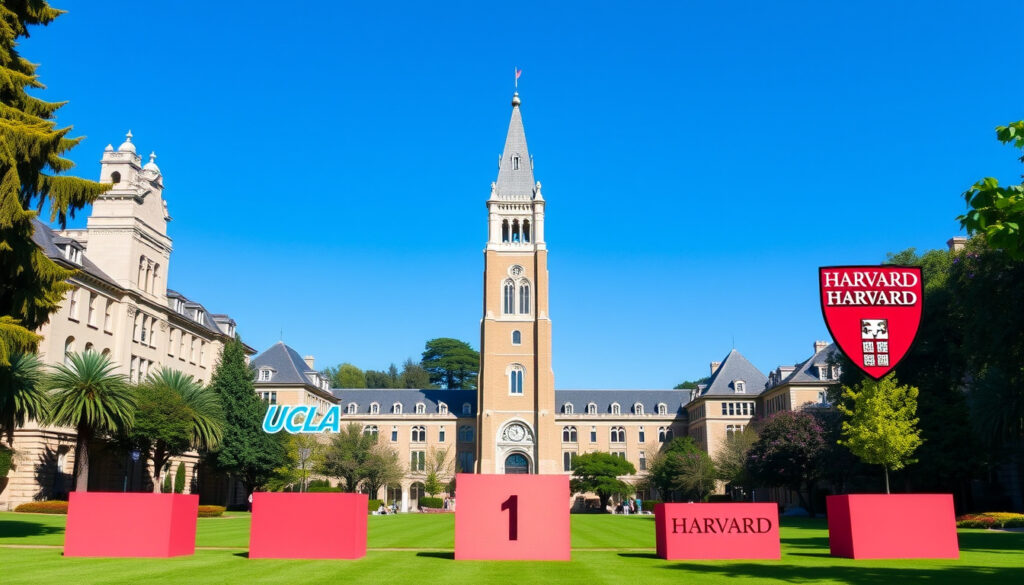
University of California, Berkeley: Rankings vs UCLA, Harvard
UC Berkeley reclaimed the #1 public university spot from UCLA in the 2026 U.S. News rankings, with acceptance rates and salary data that draw direct comparisons to Ivy League institutions. The gap with its crosstown rival is narrower than ever.
Enrollment: over 45,000 students · Degree Programs: over 300 across 15 schools · Founded: 1868 · Type: public research university · Nickname: UCB or Cal
Quick snapshot
- US News 2026 ranks Berkeley #1 public university (Empowerly)
- Fall 2025 applicants: 126,843 (Empowerly)
- Acceptance rate Fall 2025: 11% (CollegeVine)
- Exact ISO dates for all ranking releases
- Official UC system primary admissions data
- Updated 2026 tuition figures post-2025
- Founded 1868; UCLA established 1919 (University Living)
- QS 2025 rankings released; US News 2026 published
- Fall 2025 admissions cycle closed November 2024
- 2026-27 admissions cycle opens with updated criteria
- Continued competition for #1 public spot with UCLA
- Research funding exceeding $1 billion annually
Four institutional metrics appear across multiple facts and rankings in a consistent pattern: one school leads in global rankings, the other in raw application volume.
| Metric | UC Berkeley | UCLA |
|---|---|---|
| US News Public Rank (2026) | #1 | #2 |
| QS World Rank (2025) | 27th globally | 44th globally |
| Fall 2025 Acceptance Rate | 11% | 9% |
| Fall 2025 Applicants | 126,843 | 145,085 |
| WSJ Overall Rank | #8 | #68 |
| Early Career Median Salary | ~$77,000 | ~$66,500 |
| In-State Tuition (2024-25) | $14,226 | $13,258 |
| Endowment (2025) | $7.5 billion | $7.8 billion |
| Founded | 1868 | 1919 |
| Student-to-Faculty Ratio | 18:1 to 19:1 | 19:1 |
Is Berkeley a top 10 university?
Global and national rankings
By the numbers, Berkeley lands solidly in top-10 territory depending on which list you consult. The U.S. News 2026 rankings put Berkeley at #1 among public universities nationally (Empowerly), while the Wall Street Journal’s overall list places it at #8 nationally—a ranking that reflects outcomes, engagement, and mobility metrics rather than raw selectivity (LA Times). On the global stage, QS World University Rankings 2025 placed Berkeley at 27th worldwide, a position that puts it ahead of most American public institutions but still behind the Ivy League cluster at the very top.
Recent shifts vs UCLA
The rivalry with UCLA has sharpened in recent cycles. For 2026, U.S. News restored Berkeley to the #1 public position, nudging UCLA down to #2 (Empowerly). The WSJ rankings tell a more dramatic story: Berkeley at #8 overall versus UCLA at #68 (LA Times). Where UCLA leads is application volume—145,085 Fall 2025 applicants versus Berkeley’s 126,843—but Berkeley admits a higher percentage of that smaller pool, resulting in the tighter 11% versus 9% acceptance rates (CollegeVine).
Berkeley’s edge over UCLA in 2026 rankings is real but conditional. If you weight global reputation and earnings outcomes, Berkeley wins. If raw selectivity and application volume matter more, UCLA looks more selective—but that comes with a lower admit rate, not a higher standard.
Is UC Berkeley really hard to get into?
Admission stats and requirements
With an 11% acceptance rate for Fall 2025 and 126,843 applications, Berkeley operates in genuinely competitive territory (CollegeVine, Empowerly). For California residents, the minimum GPA sits at 3.0; out-of-state applicants need a 3.4 minimum (University Living). The university received 14,502 admissions from that applicant pool for Fall 2025 (Empowerly), making the math stark: roughly 1 in 9 applicants received an offer.
GPA and test score benchmarks
Successful applicants typically post SAT scores in the 1310-1530 range, with mid-50% cohorts clustering around 1400+ (CampusReel). The six-year graduation rate of 93% signals that Berkeley admits students who can actually finish—only about 7% drop out within six years (CollegeVine). The student-to-faculty ratio of 18:1 to 19:1 means class sizes stay manageable compared to larger state universities, though Harvard’s 7:1 ratio remains in a different category entirely.
Berkeley’s out-of-state tuition runs roughly $43,000–$44,000 annually before aid. For California residents, the in-state price of approximately $14,226 makes the cost-per-degree significantly more defensible than the sticker price suggests.
Is Berkeley a better school than UCLA?
Rankings comparison
The data tilts toward Berkeley on multiple dimensions. In the U.S. News 2026 public rankings, Berkeley holds #1 versus UCLA’s #2 (Empowerly). The QS global ranking places Berkeley at 27th versus UCLA’s 44th (University Living). On the Wall Street Journal list, the gap widens dramatically: Berkeley at #8 overall while UCLA sits at #68 (LA Times). Forbes similarly ranks Berkeley at #5 nationally, placing UCLA further down the list.
Programs and research
Berkeley’s institutional strengths center on STEM, technology, and quantitative social sciences—the disciplines that feed Silicon Valley hiring pipelines. Early career median salary data shows Berkeley graduates earning approximately $77,000 versus UCLA’s $66,500 (University Living), a gap that tracks with industry demand for Berkeley’s signature fields. UCLA counters with stronger programs in arts, entertainment, and certain social sciences, where the Los Angeles location creates internships and industry access that the Bay Area cannot fully replicate.
LA Times noted in 2025 analysis that “Berkeley still beats UCLA on most major rankings.” On the Wall Street Journal list, Berkeley is No. 8 while UCLA is No. 68. The implication: Berkeley’s institutional prestige translates to measurable economic returns, but UCLA offers geographic and cultural advantages that some students will value more.
Is Berkeley harder to get into than Harvard?
Acceptance rates head-to-head
By raw selectivity, Harvard remains the harder admit. Harvard’s acceptance rate of 3.5% to 6% sits well below Berkeley’s 11% (CollegeSimply, CollegeVine). Berkeley received 126,843 applications for Fall 2025 with a 11% admit rate; Harvard’s smaller class size means absolute competition for seats is fiercer even if the applicant pool differs in composition.
CampusReel analysis
CampusReel’s comparison tool frames it directly: “If you’re looking at acceptance rate alone, then Harvard University is more difficult to get into.” The gap in student-to-faculty ratios further illustrates the resource difference—Harvard’s 7:1 ratio versus Berkeley’s 18:1 to 19:1 means Harvard students get substantially more direct faculty access. Average SAT ranges also diverge: Berkeley’s 1310-1530 versus Harvard’s 1400-1600 (CampusReel).
For roughly $13,262 to $16,997 in annual net price versus Harvard’s $17,882 to $17,900, Berkeley delivers a top-10-caliber education at a substantially lower cost—particularly for California residents. The prestige gap is real, but the return-on-investment calculation favors Berkeley for most students.
Is Berkeley a little ivy?
Public Ivies explanation
The “Public Ivy” designation—coined to identify the best public universities offering Ivy League-quality education at public school prices—includes both Berkeley and UCLA (College Advisor). Berkeley’s institutional profile fits the mold: founding date of 1868 places it among America’s oldest public research universities, research funding exceeds $1 billion annually, and the six-year graduation rate of 93% demonstrates the kind of student success that characterizes elite private institutions.
Billionaire professor example
One concrete indicator of Berkeley’s elite status: the campus has produced a billionaire professor. Ion Stoica, a computer science faculty member at Berkeley, has accumulated an estimated net worth of $2.5 billion—predominantly through stakes in data analytics companies developed alongside Berkeley students and alumni. Having a billionaire faculty member teaching undergraduates is not typical even at Ivy League schools, and it signals the caliber of industry connection available at Berkeley.
Upsides
- #1 public university (US News 2026) with global top-30 standing
- 93% six-year graduation rate among highest of any US university
- Lower net price than Harvard for comparable outcomes
- Billionaire professor signal validates industry connections
- Higher early-career salary ($77k vs $66.5k UCLA average)
Downsides
- 11% acceptance rate means strong competition for most applicants
- 18:1 student-to-faculty ratio lags behind Harvard’s 7:1
- Out-of-state tuition approaching $44k before aid
- QS global ranking (27th) trails top-10 Ivies significantly
- Smaller applicant pool than UCLA despite higher selectivity
“If you’re looking at acceptance rate alone, then Harvard University is more difficult to get into.”
— CampusReel comparison analysis
“For 2026 overall rankings, UC Berkeley and UCLA are ranked the #1 and #2 public universities in the nation by U.S. News.”
— Empowerly admissions guide
The rankings picture stabilizes around three facts that do not change: Berkeley ranks #1 among public universities in the US News 2026 list, it ranks 27th globally in QS 2025, and it admits roughly 1 in 9 applicants from a pool of more than 126,000. UCLA ranks #2 among publics, 44th globally, and admits roughly 1 in 11 from a larger pool. The relative standing holds regardless of which publication you consult.
Related reading: UC Berkeley vs UCLA: Rankings, Admissions & Public Ivy Comparison · Cheapest States to Live In (for California context)
campusreel.org, blog.collegevine.com, collegesimply.com, universityliving.com, latimes.com, empowerly.com, collegeadvisor.com, talk.collegeconfidential.com
Frequently asked questions
What is University of California, Berkeley known for?
Berkeley is known for STEM disciplines, computer science, engineering, and quantitative social sciences. Its proximity to Silicon Valley generates industry connections that translate to strong early-career salaries. The campus is also a top-10 contender on global rankings and a designated Public Ivy.
How many students attend UC Berkeley?
UC Berkeley enrolls over 45,000 students across undergraduate and graduate programs, with approximately 27,000 to 33,000 undergraduates depending on the year and reporting source.
What are the top programs at UC Berkeley?
Top programs include computer science, electrical engineering, economics, political science, and environmental science. The Haas School of Business and the College of Engineering are consistently ranked among the best in the country.
Who is the top 1 university in the world?
Global ranking methodologies differ, but for public universities in the United States, UC Berkeley holds the #1 spot in the US News 2026 public rankings. Globally, Berkeley ranks 27th in QS World Rankings 2025.
What makes UC Berkeley a flagship institution?
Founded in 1868, Berkeley is the flagship campus of the University of California system. With over $1 billion in annual research funding, a 93% graduation rate, and rankings consistently placing it among the world’s best, it functions as California’s answer to the Ivy League.
How does UC Berkeley compare to other UCs?
Berkeley ranks #1 among the 10-campus UC system in US News 2026 public rankings, with UCLA at #2. Berkeley leads in global rankings, early-career salary outcomes, and STEM program prestige, while UCLA leads in application volume and arts/social science programs.
What research is UC Berkeley leading?
Berkeley’s research output exceeds $1 billion annually across fields including artificial intelligence, climate science, biotechnology, and particle physics. The Lawrence Berkeley National Laboratory and Berkeley’s involvement in CRISPR gene editing research illustrate its institutional scale.
More related posts
 Boston Celtics vs San Antonio Spurs Player Stats Mar 10, 2026
 Grilled Chicken Near Me: Delivery & Best Spots in Ireland
 Real Madrid vs Leganés: 3-2 Comeback Win Recap
 Nightmare Before Christmas Starbucks Cup – Complete Guide to Releases and Buying
 PSG – Inter Miami – 4-0 Final Score and Highlights
 Best Asian Restaurants Near Me: Dublin & Cork Guide
 Best Flan Cubano Near Me – Top Authentic Miami Spots
 The Count of Monte Cristo – Plot Summary and Character Guide