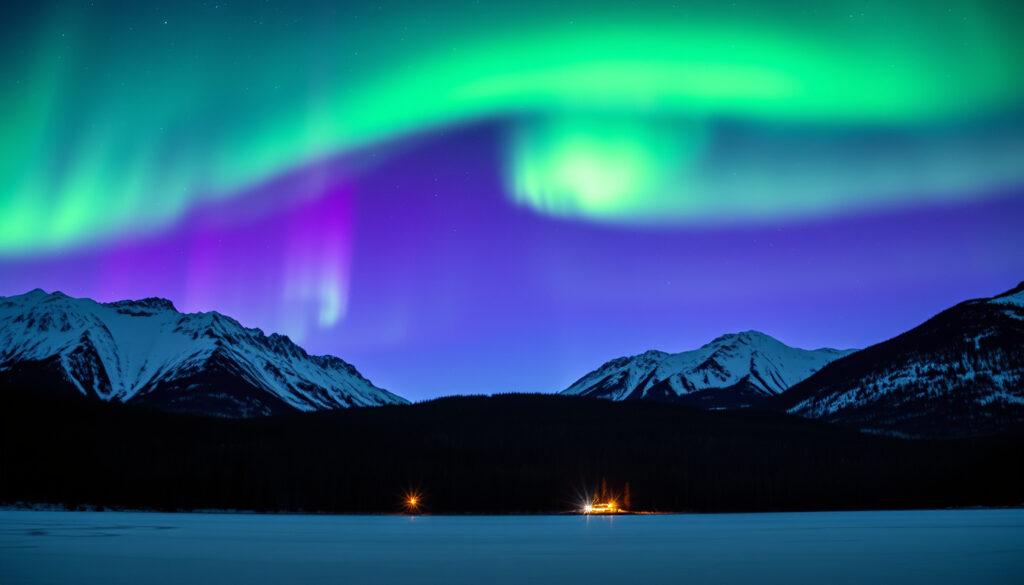
Best Places to See Aurora in Alaska: Top Locations & Tips
There’s something about standing under a green-lit sky that makes a winter trip to Alaska feel less like a vacation and more like a mission. This guide cuts through the hype to show you exactly where to go, when to book, and what you’ll actually pay to see the northern lights in Alaska — with hard numbers from official sources.
Top aurora destination: Fairbanks, Alaska ·
Aurora viewing nights per year: 200+ ·
Best month for aurora: March
Quick snapshot
- Fairbanks lies directly under the auroral oval (Explore Fairbanks (official tourism bureau))
- Aurora season runs August 21 to April 21 in Fairbanks (Explore Fairbanks Aurora Tracker)
- Best months are March and September due to equinox alignment (Travel Alaska (state tourism authority))
- Visitors staying 3+ nights have >90% chance of seeing aurora (Travel Alaska)
- Exact visibility on a specific night depends on KP index and cloud cover (Explore Fairbanks)
- Costs vary significantly by provider and season (Alaska.org (independent travel guide))
- Train ride value is subjective and not a dedicated aurora tour (Alaska.org)
- Exact Fairbanks aurora season dates depend on solar activity and weather patterns (Explore Fairbanks Aurora Tracker)
- Cost of luxury aurora packages can shift based on demand and booking window (Travel Alaska)
- Solar Cycle 25 peaked in 2024–2025; activity remains high through 2026 (Travel Alaska)
- Equinox periods (March and September) offer the best geomagnetic alignment (Alaska.org)
- Fairbanks aurora season spans August 21 to April 21 (Explore Fairbanks)
- 2026 remains a strong year for aurora as solar activity stays elevated (Travel Alaska)
- Bookings for 2026 tours at Borealis Basecamp already open from mid-November (Alaska.org)
- Aurora Pointe offers $50 per person sessions for the 2026 season (Alaska.org)
Five key facts at a glance, one pattern: Fairbanks dominates the data for both location under the oval and sheer number of viewing nights.
| Fact | Value |
|---|---|
| Auroral Oval Position | Fairbanks within oval |
| Aurora Season | Aug–Apr |
| Peak Months | Mar, Sep |
| Ideal Viewing Time | 10pm–2am |
| Recommended Stay | 3–4 nights |
What city is best to see the northern lights in Alaska?
Four locations, one clear winner on paper — but each has a role depending on what you want from the trip.
Fairbanks: The Prime Location
- Fairbanks sits directly under the auroral oval, the ring of geomagnetic activity that produces the northern lights (Explore Fairbanks (official tourism bureau)).
- The city offers 200+ viewing nights per season with a 90%+ success rate for visitors who stay three nights and actively view (Travel Alaska (state tourism authority)).
- Viewing options range from heated cabins and yurts to dog sleds and flights above the Arctic Circle (Explore Fairbanks).
Fairbanks is the only Alaska city that combines auroral-oval geography with a full travel infrastructure — lodges, guides, even a real-time Aurora Tracker from the local tourism board.
Anchorage: Limited but Possible
- Anchorage sits south of the main auroral band, so sightings are less frequent and require a KP index of 4 or higher (Alaska.org (independent travel guide)).
- Coastal weather and light pollution further reduce chances — you’ll need to drive 20–30 miles north of the city for dark skies (Travel Alaska).
Denali National Park
- Denali offers dramatic mountain backdrops and extremely low light pollution, but lodging is limited and the park’s winter road access is restricted (Alaska.org).
- Aurora can be visible from the Denali area if the KP index is moderate, but the park’s latitude (63°N) is still slightly south of the optimal oval zone.
Chena Hot Springs
- Located about 60 miles northeast of Fairbanks, Chena Hot Springs offers a unique combination: soak in geothermal hot springs while watching the aurora (Alaska.org).
- The resort sits beneath the auroral oval and has minimal light pollution; the summit of Charlie Dome provides an elevated viewing platform (Alaska.org).
The pattern: Fairbanks wins on probability and infrastructure. The trade-off is that Anchorage offers urban convenience and lower travel costs — but you’ll likely need to chase the aurora north anyway.
What is the best month in Alaska to see the northern lights?
The Peak Season: March and September
- Both months sit near the equinoxes, when the orientation of Earth’s magnetic field interacts most favorably with the solar wind (Travel Alaska (state tourism authority)).
- March offers milder temperatures (average high around 25°F) and longer daylight for pre-aurora activities, while September provides crisp fall skies with less snow.
Equinox Effect
- Geomagnetic activity is statistically higher around March 20 and September 22, boosting aurora frequency by roughly 20% over the winter average (Alaska.org (independent travel guide)).
Winter Months (December–February)
- Long nights (up to 18 hours of darkness) give plenty of viewing time, but frequent cloud cover and extreme cold (lows of -30°F) can limit comfort and success (Explore Fairbanks (official tourism bureau)).
Solar Cycle and 2026
- Solar Cycle 25 peaked in 2024–2025, but the sun remains active through 2026, meaning elevated aurora probabilities (Travel Alaska).
- Borealis Basecamp has already opened bookings for its 2026 season, starting mid-November (Alaska.org).
Why this matters: A spring equinox trip in March combines a 90%+ success probability (if you stay 3 nights) with tolerable weather. That’s the best risk-reward ratio for most travelers.
How likely is it to see the northern lights in Fairbanks?
Probability Stats
- Fairbanks averages visible aurora four out of five clear, dark nights during aurora season (Explore Fairbanks (official tourism bureau)).
- Visitors who stay a minimum of three nights and actively view every late evening have a >90% chance of seeing the aurora (Travel Alaska (state tourism authority)).
Naked Eye Visibility
- The aurora is visible to the naked eye as green arcs, bands, and curtains — no special equipment needed (Travel Alaska).
- Aurora appears brightest between 10:00 pm and 2:00 am, when the sky is darkest (Alaska.org (independent travel guide)).
Recommended Number of Nights
- Tourism officials recommend a minimum of three nights in Fairbanks to maximize your odds (Travel Alaska).
- Staying four nights pushes probability above 95% if you’re actively viewing each night.
Fairbanks’s success rate sounds too good to be true, but it’s real — because the auroral oval sits directly overhead. The catch is that you still need clear skies and a dark location away from city lights.
What this means: For a traveler, three nights in Fairbanks during March is a near-certain bet. For a cruise passenger stopping in Anchorage, the odds drop dramatically.
How much does it cost to see the aurora in Fairbanks?
Budget Options
- Single-night guided aurora tours start at around $100 per person (Travel Alaska (state tourism authority)).
- Aurora Pointe offers a 4-hour viewing session for $50 per person in 2026 (Alaska.org (independent travel guide)).
Mid-Range Lodges
- Alaska.org lists fairbanks aurora packages ranging from $699 to $959 for 14- to 15-hour combined tours (Alaska.org).
- Chena Hot Springs offers hot-springs access plus aurora wake-up calls — room rates vary from $250 to $450 per night depending on season (Alaska.org).
Luxury Tours
- Borealis Basecamp, with fiberglass igloos, lists a 2-night Adventure package starting at $2,020 for the 2026 season (Alaska.org).
- Multi-day all-inclusive packages can run several thousand dollars, depending on inclusions like flights to the Arctic Circle (Travel Alaska).
The trade-off: The cheapest options get you the same sky — but for comfort and convenience, you pay a premium for heated viewing rooms, wake-up calls, and guaranteed hot springs access.
Is the train ride from Fairbanks to Anchorage worth it?
Scenic Route
- The Alaska Railroad’s route between Fairbanks and Anchorage passes through Denali National Park, offering views of Mount McKinley and the Alaska Range (Alaska.org (independent travel guide)).
- The ride is scenic but not an aurora tour — it runs during daylight hours for most of the trip.
Time and Cost
- The train takes about 8 hours one-way and tickets range from $180 to $300 per person in the Aurora Winter season (Alaska.org).
- Round-trip would cost 16 hours of travel time and $360–$600 per person.
Alternative Transportation
- Flying between Fairbanks and Anchorage takes about 1 hour and costs around $150–$250 one-way during winter.
- Driving takes approximately 6 hours via the Parks Highway, offering flexibility to stop at Denali.
The train is a memorable daytime experience, but it eats an entire day. If your goal is aurora, you’re better off flying and using the saved time for viewing nights. For travelers who value the journey as much as the destination, the train is a worthy add-on.
Why this matters: For a 3-night aurora trip, spending 16 hours on a train doesn’t improve your odds. But for a longer itinerary combining both cities, the rail journey becomes a highlight in its own right.
Three location options, one pattern: Fairbanks outperforms on aurora metrics, Anchorage offers urban convenience, and Chena adds a hot-springs twist.
| Location | Aurora probability (3-night stay) | Cost per night (mid-range lodging) | Unique feature |
|---|---|---|---|
| Fairbanks | >90% (Travel Alaska) | $200–$400 | Under auroral oval, aurora tracker |
| Anchorage | <50% without high KP (Alaska.org) | $150–$300 | Urban amenities, airport hub |
| Chena Hot Springs | Comparable to Fairbanks (Alaska.org) | $250–$450 | Geothermal springs, Charlie Dome summit |
Timeline: Aurora activity and key periods
- 2024–2025: Solar Cycle 25 peak – excellent aurora activity (Travel Alaska)
- March Equinox: Best period for aurora due to geomagnetic alignment (Alaska.org)
- August–April: Aurora viewing season in Fairbanks (Explore Fairbanks)
- 2026: Still good aurora probability as sun remains active (Travel Alaska)
The pattern: The 2024–2025 peak is past, but 2026 remains a strong year. March equinox is your highest-odds window within the season.
Confirmed facts
- Fairbanks lies under the auroral oval (Explore Fairbanks)
- Aurora is visible with the naked eye (Travel Alaska)
- Best months are March and September (Travel Alaska)
What’s unclear
- Exact visibility on a specific night depends on KP index and weather (Explore Fairbanks)
- Costs vary significantly by provider (Alaska.org)
- Train ride value is subjective (Alaska.org)
- Aurora activity projections beyond 2026 may shift with solar cycle updates (Travel Alaska)
- Exact cost of mid-range lodges may change with seasonal demand (Alaska.org)
Fairbanks is one of the best places in the world to view the aurora borealis during Aurora Season.
— Travel Alaska (state tourism authority)
Located beneath the Auroral Oval and far from city lights, the resort offers clear views of the aurora from the hot springs to the summit of Charlie Dome.
— Chena Hot Springs (resort website)
Fairbanks and points north are the sweet spots to see the northern lights because of the main auroral band.
— Alaska.org (independent travel guide)
For the traveler who wants the highest probability of seeing the aurora in Alaska, the choice is clear: book at least three nights in Fairbanks during March or September, budget around $150–$400 per night, and use the Explore Fairbanks Aurora Tracker to pick your viewing windows. For those who can’t make Fairbanks work, Anchorage with a high KP index and a rental car north is a decent fallback — but you’ll be chasing the oval instead of standing under it.
aurorapointe.net, travelalaska.com, outerspacetrip.com, explorefairbanks.com, alaska.org, alaska.org
Frequently asked questions
Can you see the northern lights in Anchorage?
Yes, but it’s less likely than in Fairbanks. Anchorage sits south of the main auroral oval, so sightings require a KP index of 4 or higher and a drive away from city lights to the north (Alaska.org).
What is the KP index and how does it affect aurora visibility?
The KP index measures geomagnetic activity on a scale of 0 to 9. Higher numbers mean stronger aurora. In Fairbanks, a KP of 2–3 often produces visible aurora; in Anchorage, you typically need KP 4 or higher (Travel Alaska).
Do I need a guided tour to see the aurora?
No — you can see the aurora from any dark location away from city lights. But guided tours provide heated viewing spaces, knowledge of the best spots, and often photography tips. Budget tours start at about $100 per night (Travel Alaska).
What should I bring for an aurora trip?
Winter clothing rated for -20°F or colder, hand warmers, a sturdy tripod for photography, and a red-light headlamp to preserve night vision. Most tour operators provide warm drinks and heated shelters.
Are there any hotels with aurora wake-up calls?
Yes. Chena Hot Springs Resort offers aurora wake-up calls when the lights are active. Several lodges near Fairbanks, including Borealis Basecamp, provide similar services (Alaska.org).
Is it possible to see the northern lights from Denali?
Occasionally, if the KP index is moderate (3–4) and the sky is clear. However, Denali is slightly south of the optimal oval zone and has very limited winter lodging and road access (Alaska.org).
For more on travel safety and gear, check our report on the Most Dangerous Cities in America and the Best Dash Cam 2024 guide.
More related posts
 Never Gonna Give You Up: Rick Astley’s Hit and the Rickroll Meme
 Stocking Jobs Near Me in Ireland: Pay & Skills Guide
 2026 Mazda CX-90: Price, Specs, and Real-World Review
 Derivative of e^x – Proof, Explanation, Examples
 Bernese Mountain Dog Puppy: Complete Guide for Irish Owners
 How many cups in a quart? Complete conversion guide
 RB Salzburg vs Real Madrid: 3-0 Result, Stats & Analysis