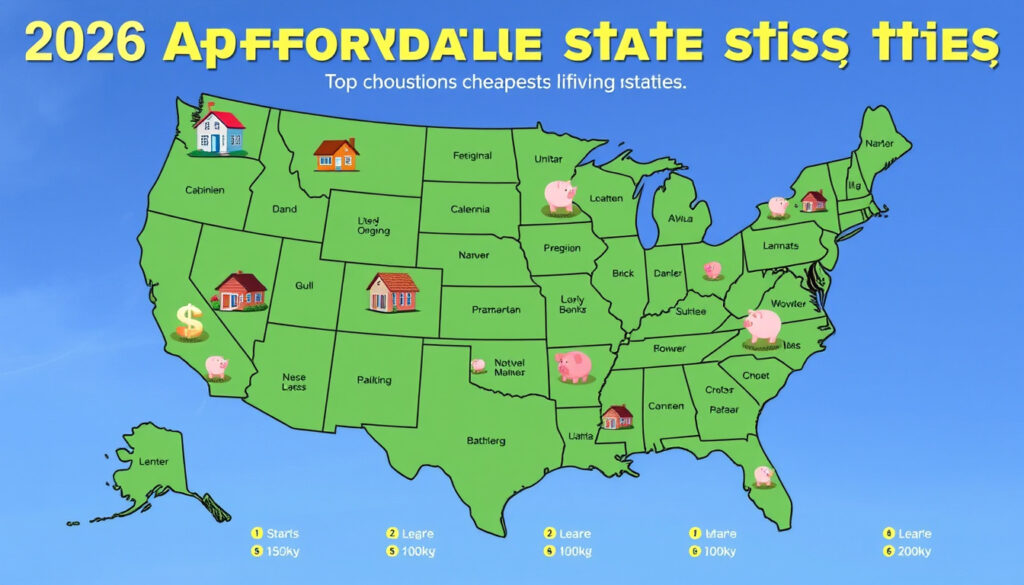
Cheapest State to Live In 2026: Top US Affordability Rankings
Millions of Americans quietly wonder which states won’t eat through their paycheck by Thursday. This guide cuts through the ranking noise to show you which states genuinely offer breathing room — and where the trade-offs bite harder than expected.
US News #1 Affordability: Arkansas · NorthAmerican Top 3: Mississippi, Oklahoma, Kansas · Remitly Cheapest Housing: Mississippi · Yahoo 10 Cheapest States: 2026 List · Reddit Cheapest City Example: Cleveland, OH
Quick snapshot
- Mississippi holds lowest COL index at 83.3 (World Population Review)
- Arkansas ranked #1 affordability by US News 2026 (World Population Review)
- National average sits at 103.4 — most cheapest states score well below (World Population Review)
- No single source agrees on the #1 cheapest state — rankings shift by methodology
- 2026 exact projections remain estimates pending full BLS data
- Quality-of-life metrics vary widely between sources
- World Population Review published 2026 COL index
- Coastal Moving Services identified Oklahoma as cheapest for 2026
- North American Van Lines ranked MS, OK, KS as most affordable for 2026
- 2026 housing market data will refine rankings as year progresses
- State tax policy changes may shift affordability calculus
- Remote work continues reshaping cheapest-state geography
| Metric | Value |
|---|---|
| Cheapest Overall (US News) | Arkansas |
| Lowest Housing | Mississippi |
| Top 3 Index | MS, OK, KS |
| 2026 Projections | Yahoo top 10 list |
| Urban Example | Cleveland OH |
What US state has the lowest cost of living?
The honest answer depends entirely on which metric you trust — and that ambiguity matters. Mississippi posts the lowest overall cost of living index at 83.3, according to World Population Review (a data aggregator that tracks state-level indices across housing, groceries, utilities, and healthcare). Oklahoma ranks lowest for total annual household expenditures at $66,284, per Coastal Moving Services (a moving-industry analysis platform). Arkansas takes the top spot in US News & World Report‘s affordability subcategory for 2026.
No single state wins across every sub-index. Mississippi leads on housing affordability (index: 66) and groceries, but Oklahoma edges it for total annual spend. Housing drives the biggest gap: West Virginia’s median home price of $117,768 beats everyone, yet its overall index sits at 88.3 — higher than Mississippi’s 83.3.
Top states by overall index
Five states consistently land in the bottom 10% of cost-of-living indices. Mississippi scores 83.3 on the World Population Review scale, meaning it’s roughly 20 points below the national average of 103.4. Oklahoma follows at 86.0, then Kansas (88.8), West Virginia (88.3), and Alabama (88.6). All five sit below the US average, which puts them in genuinely rare company.
The national average cost of living index is 103.4, per World Population Review. Hawaii, by contrast, sits at 185.0 — nearly double Mississippi’s score. That gap translates to roughly $40,000+ difference in annual household spending between the cheapest and most expensive states.
Mississippi vs Arkansas debate
Mississippi and Arkansas trade positions depending on which factor you’re measuring. Mississippi posts the lowest overall index (83.3) and dominates housing affordability — its housing index of 66 is the nation’s lowest. Average two-bedroom rent runs $991 monthly. Median single-family homes sell for approximately $255,100, per World Population Review.
Arkansas counters with US News ranking it #1 for affordability, plus lower move-in costs — GoBankingRates and Seven Seas Worldwide both rank Arkansas cheapest to move to in 2026, per Coastal Moving Services. Monthly utilities average $404.19. Two-bedroom rent sits around $1,093.
Housing costs vary sharply within states. Mississippi’s median home price ranges from $140,818 (World Population Review) to $255,100 (Coastal Moving Services) depending on methodology — a $114,000 spread that reflects how differently sources calculate metro vs. rural averages.
Which state is the cheapest and safest to live in?
Safety and affordability rarely peak in the same place — but a few cities manage both. MoneyLion (a personal finance platform) identifies affordable metros with lower crime rates, finding that several Mississippi and Arkansas cities score better than their national peers on combined metrics.
Safety-adjusted affordability
West Virginia posts the lowest required income for comfortable living for a single adult, per SmartAsset (a financial technology company offering cost-of-living calculators). The state combines an 88.3 overall index with median home prices around $117,768 — the cheapest housing in the top five cheapest states. However, West Virginia ranks lowest for economic opportunity among cheapest states, per Coastal Moving Services — jobs and wages lag behind housing savings.
Cheapest safest US places
The tradeoff is stark: states with the lowest cost of living often have weaker job markets. Tennessee and South Dakota offer zero state income tax with below-average cost of living, per Coastal Moving Services — but South Dakota’s median home price of $289,000 undercuts the housing advantage. Midwest states like Iowa, Kansas, and Nebraska offer affordability with stronger employment prospects, according to the same analysis.
Cheapest states often trade housing savings for limited career mobility. If your job travels with you, the math works. If you need a robust local job market, Midwest options like Kansas or Nebraska may cost more upfront but return more in earning potential.
Where is the cheapest but nicest place to live in the USA?
“Nice” is subjective — but quality-of-life rankings consistently reward states that blend affordability with moderate climate, cultural amenities, and healthcare access. Niche (a education and lifestyle ranking platform) publishes annual “most livable” lists that factor in cost alongside quality metrics.
Niche 2026 affordable best places
Eight of the ten most affordable states for single earners cluster in the South and Midwest, per North American Van Lines (a moving company with proprietary affordability indices). Kansas stands out as the most frequently named “nice and cheap” option — it ranks second-lowest on the cost-of-living index (86.5) with a housing index of 72.6, while offering stronger infrastructure than Deep South peers. Average single-family homes cost $176,898; two-bedroom rent averages $995.
Quality of life balance
Oklahoma rounds out the top three most affordable states based on housing, utilities, and grocery indices, per North American Van Lines. Its housing costs sit 32% below the national average, and the state’s lower population density means less traffic and more space per dollar. The catch: cultural amenities and healthcare options concentrate in Tulsa and Oklahoma City, requiring proximity to those metros for full quality-of-life benefits.
What is the nicest but cheapest state to live in?
Kansas often wins this category by default — it offers Midwest stability (fewer extreme weather events than Texas, less seismic risk than Oklahoma), solid infrastructure, and an average home price under $177,000. But “nice” depends heavily on what you value.
Single earners focus
For single earners, affordability splits between housing-dominant savings and day-to-day budget flexibility. Mississippi’s $991 average two-bedroom rent beats Kansas’s $995, but Kansas median home prices run $36,000 lower. Monthly utilities in Arkansas ($404.19) edge out both, per Coastal Moving Services.
Regional clusters
The South dominates top cheap rankings, with Mississippi, Oklahoma, Alabama, West Virginia, and Arkansas consistently occupying bottom-five positions, per Coastal Moving Services. The Midwest holds its own: Kansas, Iowa, and Nebraska offer comparable affordability with stronger job markets in some sectors. Remote workers frequently land in this Midwest corridor — affordable housing meets reliable internet infrastructure and proximity to major airports.
Can you live on $1000 a month in the USA?
Living on $1,000 monthly ($12,000 annually) is mathematically possible only in the cheapest states — and only with careful budgeting. SoFi (a personal finance platform) publishes survival budgets that show exactly which metros allow ultra-low-cost living.
Survival tips
The math breaks down like this: at $1,000/month, your rent can’t exceed $400-500 in most cities to leave room for food, utilities, transportation, and emergencies. Mississippi’s average two-bedroom rent of $991 disqualifies it for singles — that’s nearly your entire budget before food. West Virginia’s cheapest housing (median $117,768) could work if you buy instead of rent, but requires significant upfront capital.
States enabling $1k budget
West Virginia, Mississippi, and Arkansas can theoretically support $1,000/month budgets — but only with roommates, housing subsidies, or home ownership. SmartAsset notes that West Virginia offers the lowest required income for comfortable single living, which suggests it’s closest to making ends meet on minimal income. Most other cheapest states still require $20,000-30,000 annual income to cover basics without severe deprivation.
$1,000/month works only if housing is subsidized, shared, or already owned. For anyone earning minimum wage in a cheapest state, even Mississippi’s low costs leave a gap — the math only closes with remote income, savings runway, or housing assistance.
| State | COL Index | Housing Index | Median Home Price | 2BR Rent |
|---|---|---|---|---|
| Mississippi | 83.3 | 66 | $255,100 | $991 |
| Oklahoma | 86.0 | ~70 | $150,000–$200,000 | $950–$1,000 |
| West Virginia | 88.3 | ~60 | $117,768 | $850–$900 |
| Kansas | 88.8 | 72.6 | $176,898 | $995 |
| Alabama | 88.6 | ~74 | $179,400 | $1,046 |
| Arkansas | 89.6 | ~76 | $255,300 | $1,093 |
| National Avg. | 103.4 | 100 | $400,000+ | $1,500+ |
Upsides
- Housing costs 30-40% below national average in top five cheapest states
- Median home prices under $200,000 in Mississippi, West Virginia, Oklahoma
- Zero state income tax in Tennessee and South Dakota adds savings
- Midwest options (Kansas, Nebraska) pair affordability with stronger job markets
- Remote work makes cheapest-state math work for higher earners
Downsides
- Lowest-cost states often have weakest job markets and lowest wages
- No consensus #1 state — rankings vary by methodology
- Quality-of-life trade-offs: fewer cultural amenities, healthcare options
- Median home prices vary $100K+ between sources depending on metro vs. rural data
- $1,000/month budgets only viable with housing subsidies or home ownership
“Mississippi has the lowest cost of living in the U.S., with a cost of living index of 83.3.”
— World Population Review (Data Publisher)
“Oklahoma has the lowest annual cost of living in the US in 2026.”
— Coastal Moving Services (Moving Analysis)
“Housing is the primary driver of affordability in all of the cheapest states.”
— Coastal Moving Services (Moving Analysis)
Related reading: Giant Eagle Weekly Ad deals and savings tips · Sewing Classes Near Me costs and local options
Frequently asked questions
What factors determine state cost of living?
Cost of living indices typically weigh housing (typically 30-40% of the score), groceries, utilities, transportation, and healthcare. Housing alone can shift rankings dramatically — Mississippi’s 66 housing index drives its overall 83.3 score despite moderate costs in other categories.
What is the second cheapest state to live in?
Oklahoma ranks second to Mississippi on total annual household expenditures ($66,284 vs $67,147). Kansas often appears second on composite affordability indices, with a COL index of 88.8 and median home prices under $177,000.
What are the most expensive states to live in?
Hawaii tops the list at a COL index of 185.0 — nearly double the national average. California ranks third-highest at 142.2, with median home prices above $683,000 and two-bedroom rents near $1,884.
What are the cheapest states for families?
Mississippi, Oklahoma, and Arkansas lead for families prioritizing housing affordability. Kansas and Nebraska offer comparable costs with stronger school districts and job markets — better long-term value for families with children.
Is California a cheap state to live in?
No. California ranks third-highest in cost of living at 142.2, with two-bedroom rents averaging $1,884 and median home prices exceeding $683,000. Only Hawaii and a few Northeast states rank higher.
What makes a state affordable for singles?
Low rent is the primary factor for single earners. West Virginia requires the lowest income for comfortable single living, combining cheap housing ($117,768 median) with below-average daily costs. Mississippi and Oklahoma follow with average two-bedroom rents under $1,000.
How does rent affect cheapest state rankings?
Rent typically accounts for 30-40% of cost-of-living indices. Mississippi’s $991 average two-bedroom rent drives its #1 overall ranking, while states with moderate home prices but higher rents (like Colorado or Washington) rank higher in overall cost.
More related posts
 Baby Boy Names 2024: Popular, Unique & Irish Names
 How Old Is Tate McRae? Age 22, Full Biography 2025
 Queen of the Night Flower: Care, Bloom Cycle & Facts
 CT Scan vs MRI: Differences, Uses & Which is Better
 How many cups in a quart? Complete conversion guide
 Why Can’t Babies Have Honey – Botulism Risk Explained
 Why Did the Chicken Cro the Road? Joke, Game & Ri k
 United Airlines Grounds Flights: 2025 Ground Stops