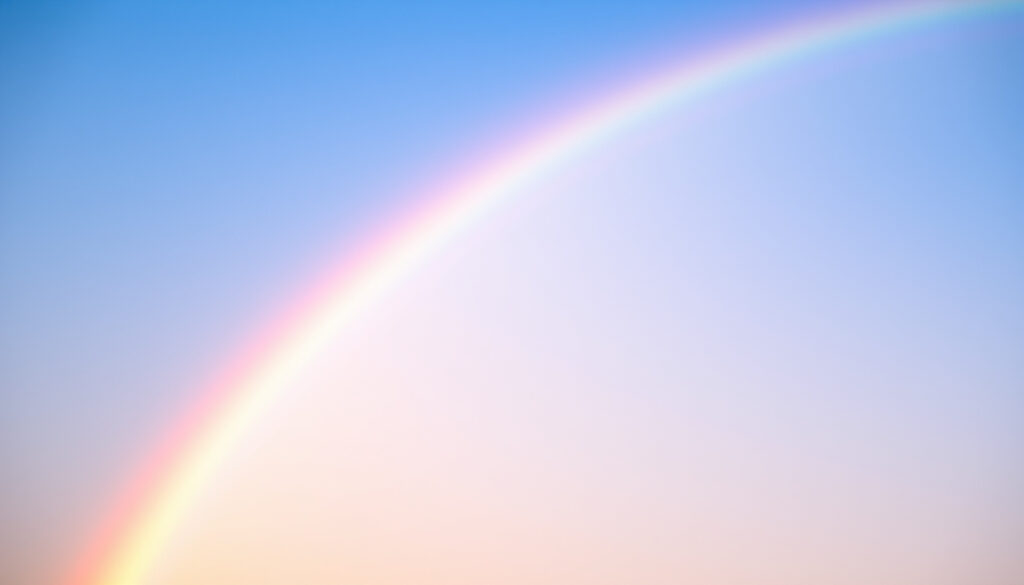
Rainbow Colors in Order: ROYGBIV Explained Simply
If you’ve ever looked up at a rainbow and wondered why it’s always red at the top and violet at the bottom, you’re not alone. The familiar seven-color sequence — red, orange, yellow, green, blue, indigo, violet — dates back to Isaac Newton’s experiments in the 1660s, who divided the continuous spectrum into seven named bands (Colour Literacy Project (science education resource)). By the end of this article, you’ll know exactly why red comes first and violet last — and why the number of colors is more convention than fact.
Traditional number of colors: 7 ·
Color order mnemonic: ROYGBIV ·
First color: Red ·
Last color: Violet
Quick snapshot
- Seven colors in fixed order: red, orange, yellow, green, blue, indigo, violet (HowStuffWorks (science explainer))
- Sequence corresponds to decreasing wavelength of visible light (Colour Literacy Project (science education resource))
- Whether indigo is a distinct color or a shade of blue remains debated (Colour Literacy Project (science education resource))
- The exact number of colors in a rainbow is culturally dependent (Wikipedia (general reference))
- Isaac Newton first described seven principal colors around 1665–1672 (Colour Literacy Project (science education resource))
- ROYGBIV acronym became widespread in the 20th century (PrepScholar (educational blog))
- Explore the science behind color perception and why some cultures see six colors (HowStuffWorks (science explainer))
- Test your memory with sentence mnemonics like “Richard Of York Gave Battle In Vain” (Woodward English (language learning site))
The pattern here is clear: the seven-color model is a human convention, not a natural law, but it remains the most practical framework for understanding the rainbow.
| Attribute | Value |
|---|---|
| Colors in traditional rainbow | 7 |
| First color | Red |
| Last color | Violet |
| Wavelength range | 380–700 nm |
| First described by | Isaac Newton (1665–1672) |
What are the 7 rainbow colors in order?
The classic list of rainbow colors, often taught in English-speaking classrooms, is a sequence of seven names: red, orange, yellow, green, blue, indigo, violet. This order runs from the outer edge of the arc (red) to the inner edge (violet) and corresponds to the decreasing wavelength of visible light (Colour Literacy Project (science education resource)).
What are the 21 colors of the rainbow with names?
Some extended lists propose more than seven colors, often including shades like pink, turquoise, or magenta. However, no authoritative scientific or educational source endorses a 21-color rainbow. The idea likely comes from poetic or artistic expansions, not from optics (HowStuffWorks (science explainer)).
While you may see longer lists on social media or craft sites, the standard seven-color model remains the bedrock of classroom science and everyday reference. Sticking with ROYGBIV keeps you aligned with both Newton’s original vision and modern educational practice.
Are there 6 or 7 colors in the rainbow?
The short answer: both. Newton deliberately chose seven colors to match the seven notes of the musical scale, a decision rooted in Renaissance-style numerology rather than strict optical evidence (Colour Literacy Project (science education resource)). Many cultures, including some in East Asia, traditionally recognize only six colors in the rainbow, omitting indigo. The spectrum is continuous — dividing it into discrete bands is a human convention.
What does 7 colors mean?
Seven colors represent the most widely used human classification of the visible spectrum. Newton assigned the seven principal colours in his 1704 work Opticks (Colour Literacy Project (science education resource)). This number stuck because it fits neatly into mnemonic patterns like ROYGBIV.
Why do some sources list only six colors?
Some educational resources present six colors (red, orange, yellow, green, blue, violet) because they consider indigo a shade of blue. This simplification is common in curricula outside the UK and US, particularly in countries where the VIBGYOR (violet → red) reverse order is taught (NewsLedger (tech explainer)).
If you’re a student taking a test in an English-speaking school, the expected answer is seven colors. Any other answer depends on your local curriculum. Always check which standard your teacher uses.
The implication: the number you cite should match your audience’s expectations, not just the physics.
What is the rarest color in a rainbow?
Red is often the least visible color in a rainbow because it requires the sun to be very low on the horizon — typically less than 42° above the ground. At higher sun angles, red light is scattered away, making the band appear narrower or absent (HowStuffWorks (science explainer)).
What factors affect color visibility in a rainbow?
Several variables control which colors pop: the size of raindrops, the angle of sunlight, atmospheric haze, and even the observer’s position. Fine, misty rain tends to produce wider and brighter bands, while heavy showers can wash out fainter colors like indigo (Colour Literacy Project (science education resource)).
If you’re hoping to spot a full seven-color rainbow, plan your sky-watching for early morning or late afternoon — low sun angles boost the chance of seeing red. And avoid thick haze, which reduces contrast between bands.
How do you remember the colors of the rainbow in order?
Sentence example: “Richard Of York Gave Battle In Vain” ·
Practice tip: Say it aloud 3 times daily
Memory aids for the rainbow color order are almost as famous as the sequence itself. Here’s how to lock it in.
What is the ROYGBIV mnemonic?
ROYGBIV is an acronym formed from the first letter of each color: Red, Orange, Yellow, Green, Blue, Indigo, Violet. Often pronounced as a name – “Roy G. Biv” – it’s the most common memory trick used in English-speaking countries (PrepScholar (educational blog)).
Are there other memory aids?
- Sentence mnemonics: “Richard Of York Gave Battle In Vain” is a classic. Another variant: “Read Out Your Good Book In Verse” (NewsLedger (tech explainer)).
- Reverse acronym: VIBGYOR helps if you need the order from violet to red (Wikipedia (general reference)).
- Visual cues: Picture a rainbow arc with red at the top and violet at the bottom. Associate the brightness with shorter vowels: red (loud), violet (soft).
What are the 12 different rainbows?
The notion of 12 rainbows isn’t a scientific classification — it’s more of a poetic or artistic idea. Some extended lists add colors like pink, magenta, turquoise, and even “indigo navy.” But in optics, only a few distinct types of rainbows exist.
Are there really 12 colors in the rainbow?
No. No authoritative source lists exactly 12 colors. The 12‑color concept may come from the 12‑color color wheel used in art (red, orange, yellow, yellow‑green, green, blue‑green, blue, violet‑blue, violet, magenta, etc.). Confusing a color wheel with a rainbow leads to the misconception (HowStuffWorks (science explainer)).
What are the different types of rainbows?
- Primary rainbow: The classic arc, red outside, violet inside.
- Secondary rainbow: Fainter, with reversed colors, formed by double reflection inside raindrops.
- Double rainbow: Both primary and secondary visible together.
- Supernumerary rainbows: Extra pale bands inside the primary arc caused by interference (Wikipedia (general reference)).
- Monochrome rainbows: Produced when the sun is very low; only red or only blue may appear.
If you search for “12 colors of the rainbow,” you’ll find many lists – but they are artist interpretations, not physics. For a school project, stick with the seven‑color model; for creative work, feel free to borrow from the 12‑step color wheel.
What this means: when you hear “12 rainbows,” the speaker is almost certainly referring to an artistic palette, not a meteorological phenomenon.
How to Memorize the Rainbow Colors: A Step-by-Step Guide
- Learn the acronym first. Write ROYGBIV on a sticky note and place it where you’ll see it daily. Say it as a name: “Roy G. Biv.” (wikiHow (practical guide)).
- Assign each letter to a color. R=Red, O=Orange, Y=Yellow, G=Green, B=Blue, I=Indigo, V=Violet. Recite the list while pointing to a real rainbow photo.
- Create a silly sentence. “Richard Of York Gave Battle In Vain” works because the initial letters match exactly. Make up your own if that helps.
- Practice backwards. Memorize VIBGYOR (violet to red) to strengthen recall.
- Test yourself at random times. While waiting for coffee or commuting, mentally run the sequence forward and backward until it becomes automatic (Science Insights (learning resource)).
After a week of daily practice, you’ll have the order committed to long‑term memory.
Confirmed facts
- The order of colors in a rainbow is always red, orange, yellow, green, blue, indigo, violet when using the traditional seven-color model.
What’s unclear
- Whether indigo is a distinct color or just a shade of blue is debated.
- The exact number of distinct colors in a rainbow is arbitrary and culturally dependent.
Key Perspective from Historical Sources
“The Spectrum itself is a continuous series of colours, but I have thought it convenient to distinguish them by the following seven names: Red, Orange, Yellow, Green, Blue, Indigo, Violet.”
— Isaac Newton, Opticks, 1704 (Colour Literacy Project (science education resource))
“The mnemonic ROYGBIV is far more than a schoolroom trick — it encodes the order of wavelengths from long (red) to short (violet) and has been used for centuries to teach the basics of optics.”
— HowStuffWorks, Rainbow Colors explainer (HowStuffWorks (science explainer))
Newton’s choice of seven colors may have been influenced by the musical scale, but the exact number matters less than understanding that the rainbow is a continuous spectrum. The poetic side — the awe of seeing a perfect arc — is what keeps these old conventions alive in classrooms and culture.
Related reading: **Newton’s Laws of Motion: 1st, 2nd, 3rd with Formulas & Examples** · **Newton’s Laws of Motion: Definitions, Formulas, and Examples**
youtube.com, en.wikipedia.org, homeschoolwithlove.com, websitewithnoname.com
Frequently asked questions
Can you see all seven colors in every rainbow?
No. Red is often missing at high sun angles, and indigo can blend into blue (HowStuffWorks (science explainer)).
Why is indigo considered a separate color?
Because Newton wanted seven colors to match the seven notes of the musical scale. Without that historical reason, indigo would likely be classified as a shade of blue (Colour Literacy Project (science education resource)).
What is the acronym for the rainbow colors?
ROYGBIV for the order from red to violet. VIBGYOR for the reverse order (PrepScholar (educational blog)).
How many colors can the human eye see in a rainbow?
The human eye can distinguish about 100–150 distinct hues across the visible spectrum, but the culture‑based naming system usually stops at six or seven (Colour Literacy Project (science education resource)).
What does the order of rainbow colors tell us about light?
It shows that white light is composed of a continuous range of wavelengths, each bending at a slightly different angle when passing through water droplets. Red bends least, violet most (HowStuffWorks (science explainer)).
Why do some artists use 12 colors for rainbows?
Artists often expand the palette to include transitional shades like yellow‑green or red‑violet to create more nuanced color wheels, not to represent actual rainbows (Wikipedia (general reference)).
More related posts
 Money in the Bank 2025 Results, Card, and Streaming Info
 La Liga 2 Standings 2025-26: Promotion, Relegation & Table Guide
 White New Balance Shoes: Style, Etiquette & Foot Health
 Molly Ringwald Movies & TV Shows: Complete List
 Let It Be Lyrics: Story, Meaning, and John Lennon’s Criticism
 Tyler Perry Net Worth: How He Built $1.4 Billion Empire
 George Floyd’s Criminal Record: Verified Facts vs. Misinformation
 Espanyol vs FC Barcelona Lineups: Derby History & Preview