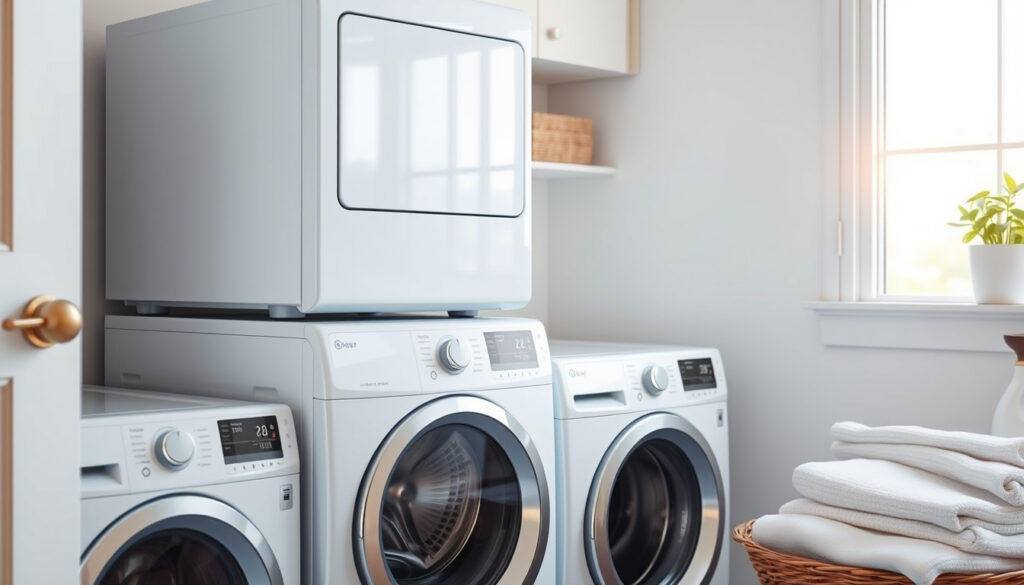
Stackable Washer and Dryer: Pros, Cons & Setup Guide
Anyone who’s tried squeezing a full-size washer and dryer into a tight apartment knows the frustration. Stackable units solve that by letting the dryer sit on top of the washer, reclaiming precious floor space — a typical setup measures about 27 inches wide and can cut the footprint by up to 50% compared to side-by-side models, according to Maytag (appliance manufacturer).
Average lifespan of a stackable washer/dryer: 10–15 years · Typical price range: $1,000 – $2,500 · Floor space saved vs. side-by-side: Up to 50% · Common configuration: Washer on bottom, dryer on top · Stacking kit cost: $50 – $150
Quick snapshot
- Stacking saves floor space (Maytag)
- Most sets require a stacking kit (Whirlpool)
- Front-load washers are standard for stacking (Maytag)
- Average lifespan is 10–13 years (Consumer Reports)
- Whether stacking increases vibration-related wear on the washer
- Exact failure rates compared to side-by-side units over 15 years
- Installation time (1–2 hours) depends on conditions
- Stacking kit lifetime not independently verified
- Average lifespan: 10–13 years (Consumer Reports)
- Measure space carefully before buying
- Confirm compatibility and stacking kit availability
- Plan for venting and electrical requirements
Six key specs, one pattern: stackable dimensions are remarkably standardized, making space planning simpler than many buyers expect.
| Spec | Value |
|---|---|
| Typical washer width | 27 inches |
| Typical washer height | 34–39 inches |
| Dryer on top added height | 27–34 inches |
| Total stacked height | 61–73 inches |
| Stacking kit cost | $50–$150 |
| Average lifespan | 10–13 years |
What is a stackable washer?
A stackable washer is a separate front-load washing machine designed to be placed underneath a compatible dryer using a stacking kit. It is not the same as a washer-dryer combo — that’s a single machine that washes and dries in one drum. Stackable units keep two independent appliances, so you can replace either individually.
How does a stackable washer differ from a washer-dryer combo?
- Stackable = two machines, one on top of the other (Whirlpool)
- Combo = single unit that washes and dries in the same drum
- Stackable typically offers larger total capacity than most combos
What are the typical dimensions and weight limits?
Most stackable sets are 27 inches wide. The washer alone stands 34–39 inches tall; adding the dryer brings total height to 61–73 inches. Maytag (appliance manufacturer) recommends allowing at least 1–5 inches of clearance on each side and on top for vibration and movement. The washer must support the dryer’s weight, typically 100–150 lbs.
What to consider before buying a stackable set
- Measure your space: width (27 inches typical), height (61–73 inches stacked), depth (32–34 inches plus 5 inches for hoses and venting) — per Maytag
- Check compatibility: not every washer can be stacked (Whirlpool)
- Consider venting: dryers need 4-inch metal duct and as few elbows as possible (Alliance Laundry Systems (commercial laundry equipment manufacturer))
- Floor condition: must be solid, level, and not on carpet (Alliance Laundry Systems (commercial laundry equipment manufacturer))
The pattern: stackable units trade vertical height for floor space, but compatibility constraints make them less flexible than side-by-side.
Which is better, a stackable washer and dryer or a side by side?
Choosing between stackable and side-by-side depends on space, budget, and how often you need to service the machines. The table below shows the trade-offs.
| Criterion | Stackable | Side-by-side |
|---|---|---|
| Space efficiency | Saves up to 50% floor area; fits in a closet | Requires about 54–60 inches of width |
| Installation cost | Add $50–$150 for stacking kit | No extra hardware needed |
| Ease of maintenance | Harder to access washer controls and rear connections | Easy access to both units |
| Performance & capacity | Similar when using comparable models | Similar when using comparable models |
The catch: stacking can make repairs more difficult, and if you ever need to move one unit, you have to unstack them. Side-by-side wins on serviceability, but stackable wins where every square foot counts.
What is the best brand of stackable washer and dryer?
LG, Samsung, Whirlpool, Maytag, and GE dominate the market. Consumer Reports (independent product testing organization) recommends filtering by stackable compatibility first, then checking reliability scores.
Top brands
- LG and Samsung — often praised for compact designs, smart features, and quiet operation
- Whirlpool and Maytag — known for durability, serviceability, and wide availability of parts
- GE — strong mid-range options with solid warranty coverage
Factors to consider
- Capacity: compact sets (2.0–2.4 cu ft) vs. full-size (4.5+ cu ft)
- Reliability: check owner satisfaction data from Consumer Reports
- Warranty: typical one-year parts and labor, longer on some components
- Stacking kit: must be brand-specific and model-specific (Whirlpool)
Premium brands like LG and Samsung offer the most features, but their proprietary parts can cost more down the road. Whirlpool and Maytag make service easier for DIY homeowners.
The implication: brand choice hinges on whether you prioritize features or ease of repair.
How to set up a stackable washing machine and tumbler dryer?
Setting up a stackable set is a straightforward DIY job if you have help, but mistakes can be dangerous. Here are the steps recommended by manufacturers.
- Check compatibility and weight limits: Confirm both appliances are designed for stacking — not every model works (Whirlpool). Verify the washer can support the dryer weight (100–150 lbs typical). Use the specific stacking kit for your brand(s) (Whirlpool).
- Install the stacking kit: Follow the kit instructions precisely — brackets and screws vary by brand. Secure the kit to the top of the washer first.
- Position the dryer on top of the washer: Lift the dryer onto the washer with at least one other person (Maytag). Align the dryer’s feet with the kit brackets.
- Secure and test stability: Lock the dryer into the stacking kit with the provided hardware. Use a level to check side-to-side and front-to-back (Alliance Laundry Systems (commercial laundry equipment manufacturer)). Run a short cycle to check for excessive vibration.
Incompatible stacking can cause the top appliance to fall and may void the warranty, warns Whirlpool. Never stack without manufacturer-approved hardware.
What this means: proper installation is critical for safety, and skipping the stacking kit is never worth the risk.
What is the lifespan of a stackable washer and dryer?
Most washers and dryers last 10–13 years on average, and stackable units share that longevity. Consumer Reports data shows that compact models often have slightly shorter cycles but comparable durability. The downsides of stacking — vibration, harder service access, and the need for a solid floor — can shorten life if ignored.
Factors that affect longevity
- Vibration from poor leveling can damage internal components over time (Alliance Laundry Systems (commercial laundry equipment manufacturer))
- Regular cleaning of lint filters and drain pumps extends life
- Service access is harder when units are stacked, potentially increasing repair costs
Signs it’s time to replace
- Excessive noise or vibration during operation
- Water leaks or inability to drain
- Frequent breakdowns requiring expensive repairs
The washer bears the full weight of the dryer plus its own vibration. Alliance Laundry Systems (commercial laundry equipment manufacturer) notes that floors above basements or second stories may need reinforcement — something many buyers overlook.
Upsides
- Major space savings
- Same performance as side-by-side
- Flexible placement options
Downsides
- Harder to service
- Requires stacking kit
- Vibration can accelerate wear
The catch: while lifespan matches side-by-side, the added vibration and service difficulty may reduce actual usable life in many homes.
What we know and what remains unclear
Confirmed facts
- Stacking saves floor space (Maytag)
- Most sets require a stacking kit (Whirlpool)
- Front-load washers are standard for stacking (Maytag)
- Average lifespan is 10–13 years (Consumer Reports)
What’s unclear
- Whether stacking increases vibration-related wear on the washer
- Exact failure rates compared to side-by-side units over 15 years
The pattern: much of the long-term reliability data comes from consumer reports, but independent comparative studies are scarce.
“Always use a stacking kit designed for your specific washer and dryer models. Incompatible stacking can cause the top appliance to fall and may void the warranty.”
— Whirlpool (appliance brand)
Consumer Reports recommends filtering its tested compact or front-load washers to see which ones are stackable before searching for a companion dryer.
— Consumer Reports (independent product testing organization)
For apartment dwellers, the choice is clear: stackable units maximize limited space, but require careful installation and maintenance. Ignoring floor strength, venting, or compatibility can turn a space-saving solution into a costly headache. Measure, match, and secure — or stay side-by-side.
Related reading: How to Remove Wallpaper Without a Steamer · O-Cedar Spin Mop Review
If you are comparing models, our guide to best stackable washer and dryer picks for small spaces can help narrow down your options.
Frequently asked questions
Can you stack a washer and dryer without a stacking kit?
No. Whirlpool warns that stacking without a manufacturer-approved kit risks the top unit falling and voids the warranty.
Do stackable washer and dryer sets come as a single unit?
They can be sold as a bundled set (two separate machines) or purchased individually. A stacking kit is still required.
Are stackable units more expensive than side-by-side?
Not necessarily — comparable models cost about the same. The stacking kit adds $50–$150.
What is the maximum weight for the dryer on top?
Most washers can support 100–150 lbs. Check your washer’s specifications and the stacking kit rating.
Can you stack a top-loading washer?
No — stackable sets require front-load washers because the dryer sits on a flat surface.
How do you separate a stacked washer and dryer?
Unplug both units, remove the stacking kit hardware, and carefully lift the dryer off with help. Follow the reverse of the installation steps.
Do stackable units need special venting for the dryer?
Yes — dryers should use 4-inch diameter rigid or flexible metal duct with as few elbows as possible (Alliance Laundry Systems).
More related posts
 Cheapest State to Live In 2026: Top US Affordability Rankings
 Ji Chang-wook: Age, Height, Dramas & Personal Life Facts
 Complete List of Sabrina Carpenter Movies and TV Shows (2025)
 Kendrick Lamar Super Bowl Halftime Show: Controversy & Meaning
 CT Scan vs MRI: Differences, Uses & Which is Better
 George Russell Gilded Age: Real-Life Inspiration Explained
 Things to Do in Washington DC: Attractions, Tips & Safety