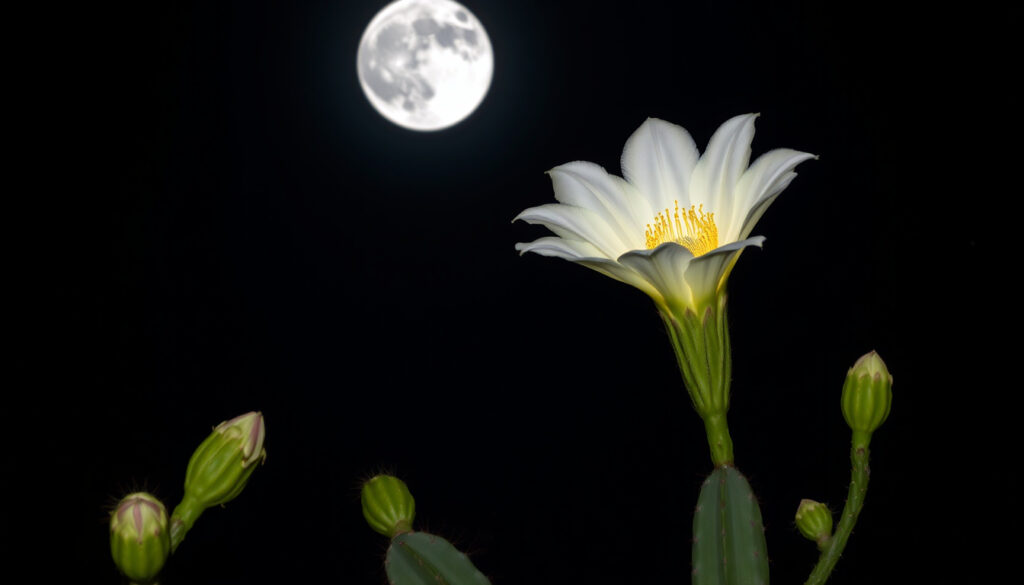
Queen of the Night Flower: Care, Bloom Cycle & Facts
A flower that appears for one night and vanishes by morning might sound like a legend. For the Queen of the Night (Epiphyllum oxypetalum), that legend is real — and it blooms in living rooms across the country.
Bloom Duration: Single night, wilts before dawn ·
Bloom Cycle: Typically once per year, occasionally more ·
Flower Size: Up to 12 inches (30 cm) across ·
Scientific Name: Epiphyllum oxypetalum ·
Fragrance Intensity: Strong, sweet perfume
Quick snapshot
- Blooms at night, wilts by dawn (Planet Desert (specialty cactus nursery))
- Scientific name Epiphyllum oxypetalum (New York Botanical Garden (botanical research institution))
- Exact triggers for re-bloom in the same year (Fifth Season Gardening (garden center))
- Precise frequency of multiple blooms indoors (Ohio Tropics (indoor plant specialist))
- Single-night bloom, flowers open after sunset, wilt before dawn (Wikipedia (encyclopedic source))
- Bloom season: summer to fall (Ohio Tropics (indoor plant specialist))
- After bloom, plant enters rest period; reduce watering for 2–3 weeks (New York Botanical Garden (botanical research institution))
- Next bloom may occur in the same year under ideal conditions (Fifth Season Gardening (garden center))
Six key facts, one takeaway: the Queen of the Night is more predictable than its myth suggests.
| Attribute | Value |
|---|---|
| Scientific Name | Epiphyllum oxypetalum |
| Common Names | Queen of the Night, Night-blooming Cereus, Dutchman’s Pipe |
| Native Range | Mexico, Central America |
| Bloom Season | Summer to fall |
| Bloom Duration | Single night |
| Mature Height | 6–10 feet (1.8–3 m) |
How rare is the Queen of the Night flower?
The plant itself is common; the bloom is brief. That contradiction fuels the flower’s mystique — but it doesn’t make the plant hard to own.
Rarity factors
- The plant is widely cultivated as a houseplant and is not endangered. According to the New York Botanical Garden (botanical research institution), it adapts easily to indoor conditions.
- Rarity refers only to the fleeting bloom — each flower opens for a single night and wilts by dawn, as noted by Planet Desert (specialty cactus nursery).
Bloom frequency
- Most plants flower once per year, though some may bloom twice under ideal conditions, according to Fifth Season Gardening (garden center).
- Ohio Tropics (indoor plant specialist) confirms that the bloom season spans spring and summer.
Comparisons to other night-blooming plants
- Other night-blooming cereus species (e.g., Selenicereus grandiflorus) also flower for a single night, but Epiphyllum oxypetalum is the most commonly grown indoors (LG Gardening (home gardening resource)).
The pattern: the flower’s rarity is a matter of timing, not availability. Anyone who wants one can grow it.
Why is the Queen of the Night flower special?
Nocturnal blooming
- The flowers open after sunset and close before sunrise — a trait that evolved to attract night-pollinating moths and bats, as described by Planet Desert (specialty cactus nursery).
Fragrance intensity
- The strong, sweet perfume is released only at night, making it a sensory event for anyone nearby. Ohio Tropics (indoor plant specialist) notes that the scent is one of the plant’s most celebrated features.
Flower size
- The New York Botanical Garden (botanical research institution) reports that the funnel-shaped flowers can reach 4 inches (10 cm) in diameter, while other sources, including Planet Desert (specialty cactus nursery), describe flowers up to 12 inches (30 cm) across.
Why this matters: each bloom is a rare, multisensory experience that rewards patient growers.
Why does Queen of the Night only bloom once?
“Only once” is not a strict rule — it’s the default. With the right environmental cues, some plants will rebloom within weeks.
Bloom cycle explanation
- The plant follows a natural cycle of growth and rest. After flowering, it typically needs a recovery period of reduced watering, as recommended by the New York Botanical Garden (botanical research institution).
- Most plants reach blooming maturity at 3–5 years of age, according to LG Gardening (home gardening resource).
Environmental triggers
- Photoperiod and temperature play key roles. A winter “chill period” with nighttime temperatures between 35–60°F reportedly encourages bud formation, per LG Gardening (home gardening resource).
- Restricting water from November through March, combined with cooler temperatures, is a common technique used by growers, the same source notes.
Factors that affect re-bloom
- Plants that are large, well-fed, and grown in optimal light may produce multiple flowering episodes in a single season. Fifth Season Gardening (garden center) reports that some plants flower off and on over a period of a month.
The trade-off: a strict rest period can increase bloom reliability, but it also means you won’t get flowers year-round.
How do you take care of the Queen of the Night flower?
- Place in bright indirect light; avoid direct sun that burns leaves.
- Water deeply but infrequently, allowing soil to dry between waterings.
- Use a well-draining cactus or succulent potting mix.
- Fertilize monthly during spring–early fall with a balanced, half-strength fertilizer.
- Provide a winter rest: reduce watering and keep temperatures 35–60°F at night.
Light requirements
- Bright indirect light is ideal. The New York Botanical Garden (botanical research institution) advises medium indoor light and says full sun is not necessary.
- Ohio Tropics (indoor plant specialist) calls proper light the most important factor for flowering: too much direct sun burns the leaves, while too little suppresses bloom.
Watering needs
- Water deeply but infrequently. The plant needs excellent drainage because it is epiphytic — it should never sit in water, cautions Ohio Tropics (indoor plant specialist).
- The New York Botanical Garden (botanical research institution) recommends watering thoroughly in spring and summer, then giving the plant a brief rest of 2–3 weeks after flowering by watering only enough to prevent complete drying.
- LG Gardening (home gardening resource) notes that during the rest period (November–March), reduce watering significantly — some growers use it as a dry spell to encourage blooms.
Soil and repotting
- Use a well-draining potting mix formulated for cacti or succulents. Planet Desert (specialty cactus nursery) stresses the need for infrequent deep watering and soil that dries out between waterings.
- Repot every 2–3 years or when roots outgrow the container; the plant tolerates being slightly root-bound.
Fertilizer schedule
- Feed monthly during the growing season (spring to early fall) with a balanced, water-soluble fertilizer diluted to half strength. Fifth Season Gardening (garden center) recommends using a fertilizer higher in phosphorus to encourage flowering.
The implication: consistent care yields a reliable bloom year after year.
Does the Queen of the Night flower only bloom once a year?
Annual bloom pattern
- For most indoor plants, the answer is yes — one flowering episode per year, typically in summer. Ohio Tropics (indoor plant specialist) confirms this as the norm.
Occasional multiple blooms
- Under very favorable conditions — ample light, stable temperatures, and proper nutrition — some plants can flower twice in a year, as documented by Fifth Season Gardening (garden center).
The pattern: the default is one bloom per year, but the plant is capable of more when conditions mimic its native tropical environment.
How much is a Queen of the Night flower worth?
Price range for plants
- The Queen of the Night is widely available and affordable. Small cuttings or starter plants from specialty nurseries and online retailers typically cost $10–$25, while mature, well-established specimens can range from $30 to $80.
Factors affecting cost
- Size, age, and pot quality drive the price — not the bloom’s mystique. Because the plant is common in cultivation, the cost reflects horticultural effort rather than rarity (Planet Desert (specialty cactus nursery) confirms it is a commonly grown houseplant).
Where to buy
- Check local garden centers, cactus nurseries, or online specialty stores such as Planet Desert and Plant Delights. Cuttings are often shared among plant enthusiasts at low cost.
The implication: the flower’s perceived value is emotional, not commercial. Anyone can own one for the price of a pizza.
Beware of sellers marketing “rare Queen of the Night seeds” at inflated prices — the plant is widely propagated from cuttings and is not hard to find.
“The flowers of Epiphyllum oxypetalum are short-lived, opening at night and wilting before dawn. They are strongly fragrant and can be up to 12 inches across.”
“Queen of the Night is a spectacular night-blooming cactus that produces large, fragrant white flowers. It thrives in bright filtered light and high humidity.”
— Fifth Season Gardening (garden center)
“In Central American folklore, the Queen of the Night is associated with mystery and transformation, often symbolizing a brief but intense moment of beauty.”
— Center for Latin American and Caribbean Studies (academic institute)
For the home grower, the choice is clear: invest in patience rather than price. A well-tended Queen of the Night will reward you with one of the most memorable nights in horticulture — or several, if you master the rest period.
Frequently asked questions
What does Queen of the Night flower smell like?
Its scent is sweet, heavy, and intensely floral — often compared to gardenia or jasmine, but stronger. The aroma is released only at night, peaking when the flower is fully open.
Can Queen of the Night grow indoors?
Yes. It is one of the most adaptable epiphytic cacti for indoor life. The New York Botanical Garden confirms it grows well in medium indirect light with high humidity.
When does Queen of the Night bloom?
Typically between summer and fall. Individual flowers open at dusk and last only one night. The plant may produce multiple blooms over several weeks.
How long does the flower last?
One night. The bloom opens after sunset and wilts before dawn the next morning.
Is Queen of the Night poisonous to pets?
There is no confirmed evidence of toxicity, but the ASPCA does not list Epiphyllum oxypetalum as toxic to cats or dogs. Still, keep it out of reach to avoid digestive upset.
Should I cut off dead flowers from Queen of the Night?
Yes. Remove spent blooms to keep the plant tidy and redirect energy into new growth or next year’s buds. Use clean, sharp scissors.
How fast does Queen of the Night grow?
Moderately fast in the growing season. Under bright indirect light and consistent watering, it can grow several feet per year, reaching mature length in 2–3 years.
More related posts
 Sydney Sweeney American Eagle Ad: Controversy & Earnings
 Breakfast Tacos Near Me: Best Dublin & Ireland Spots
 Best Water Shoes for Women 2026 – Tested & Reviewed
 Mac N Cheese Recipe: 3 Easy Methods (Stovetop, Baked & Chef)
 Rainbow Colors in Order: ROYGBIV Explained Simply
 Tallest Building in the World: Burj Khalifa & Top 10 2026
 Best Dash Cam 2024: Expert Tested and Reviewed Top Picks
 Jelly Roll and Bunnie XO Divorce: Reasons & Timeline 2026